
“Drink to me only with thine eyes…”
If you’ve ever asked yourself what type of person writes poetry – (tho perhaps you haven’t) – the answer is simple.
All types; all kinds.
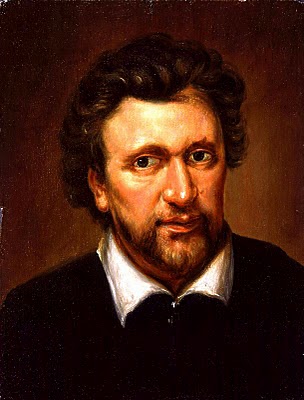
Take, for example, my old friend Ben J.

Ben started out very low on life’s ladder. He was a bricklayer and a sort of general handyman.
And he wound up as one of the greatest writers – playwright as well as poet – in the history of English literature.
Like most bricklayers of 400 or so years ago Ben, whose last name was Jonson by the way, was unable to go to university, so he decided to educate himself. He became one of the best-educated men in the country.

Ultimately, Oxford University, which earlier wouldn’t have allowed him to so much as deliver a pizza to the back door, granted him an MA.
When he wasn’t occupied writing poetry and plays, he kept busy by getting in trouble. He was a kind of psychological train wreck (which wasn’t all that easy hundreds of years before trains). If you check out his rap sheet it’s almost unbelievable:
He killed two people. You'd have to search for quite a while before you could find many other poets about whom you could you say such a thing.
He had killed a soldier in man-to-man combat in the Low Countries, and he killed another man in a duel. He was also locked up in the poky from time to time just for “leude and mutynous” behavior, which seemed to sort of sum up his life.
(It’s worth pointing out that the report of his heroic man-to-man combat experience while he was in the army came from him; no one else ever mentioned it.)
As for the duel, that actually happened, and Ben was in trouble. It was not trivial; he could have been hanged for such a killing.
He managed to get off by using a legal ploy, something that says a lot about Elizabethan life. He got off by pleading “benefit of clergy.”
It worked, even though there were few who knew him who would ever have described Ben Jonson as clergy, or even having much to do with clergy.
You see, there were so few educated people in England at that time that authorities decided it would be best not to execute a person if he could prove he could read and write. In that case he would be considered to be “clergy.” Ben did well in this test: he aced the exam. He got off lightly: he was just branded with the mark of a felon.

This tough guy was capable of magnificent writing. Check out this week’s prompt. How many bricklayers do you know who could write a poem as light and lovely as “Drink to Me Only With Thine Eyes,” which Ben did.
"Drink to me only with thine eyes,
And I will pledge with mine.
Or leave a kiss within the cup
And I'll not ask for wine."
If Ben Jonson were around today, my guess is he would probably be described as “deviant”; he would be a writer of plays for off-off-Broadway, and he would usually be dressed, even for formal occasions, in worn-out jeans and a dirty T-shirt with an offensive motto printed on the front, and he would be sporting a huge bushy beard, with minuscule bits of whatever he had for breakfast embedded in it.
Jonson was Will Shakespeare’s friend/competitor/nag and general pain-in-the-neck.

Ben regarded with amusement his pal Will’s efforts to turn himself into a gentleman. It would seem Ben especially got a kick out of the Shakespeare coat of arms, with its “Not Without Right” motto. We know this because Jonson proceeded to write a play that features a character who has received a coat of arms (which he got through bribery); the character, by the way, is a clown.
His coat of arms has a picture of a boar, with a three-word motto beneath: “Not Without Mustard.”
Everyone who was in any way connected with the theatre in London at that time undoubtedly found that hysterically funny. It’s probable that Our Will wasn’t as amused.

As a totally irrelevant side comment, Pocahontas – yes that Pocahontas – was in England and was actually in the audience for one of Ben’s productions.
Ben Jonson died on Aug. 6, 1637. His story ends in this way: once he was safely dead, the country decided that he was one of the foremost men of letters of his age and he was buried with great ceremony in Westminster Abbey.
(He was one up on his friend Will; Shakespeare was not buried in Westminster Abbey.)

Ben was buried under a slab on which was carved the words, “O Rare Ben Jonson!”
He was rare; there were none rarer.
(Submitted also to "Sunday Scribblings.")