Sunday, March 23, 2014

212 Quiz Answer


The answer: King Claudius decides to send the obstreperous Prince Hamlet on a trip to England.  England owes tribute to Denmark so the King also sends a sealed letter ordering that the youth be put to death upon his arrival there.  But Hamlet manages to read the letter…

(Also for Three Word Wednesday and ABC Wednesday: "K" is for "Kevin")
Here’s this week’s Berownial quiz question.  I wrote the following scenelet, thinking it might remind you of a well-known play.  Which play?
“At times you can be so – so exasperating!”

“Now, calm down, Mom.  You said you wanted to talk so let’s talk in a reasonable way.”

“But you’ve been offered a marvelous gift, a trip to England, all expenses paid, that just about anyone would be delighted with, and you say you’d rather not go!”

“Well, I appreciate it, of course.  It’s just that I have so much to do here at home.”

“’So much to do?’  All you do is mope about in your emaciated way, carping and complaining and driving everyone a little crazy.  Look.  You’ve always been interested in history; well, this gives you a chance to learn first hand about other lands.”

“Mom, listen.  Of course I’d love a trip like that.  It just comes at a bad time, that’s all.  And there’s something else – something sort of hard to talk about.”

“It’s Kevin, isn’t it?  Because you don’t get along with him you’re going to turn down the chance of a lifetime.  Why, the poor man has done everything he could for you and you just keep that chip on your shoulder, barely even being polite with him.  And now he’s offering you this wonderful gift.”

“That’s sort of just it.  Why does he want to send me off?  I have the odd feeling he just wants me out of the way.”

“Oh, that’s nonsense.  Someone tries to do something for you and you immediately suspect an ulterior motive.  You should show your appreciation.  You are going to go on that trip, even if we have to force you.”

“Think about this.  Just suppose – just for a moment – that I’m right.  That he’s being so generous just because. in a cunning way, he wants me out of here.  Well, the two of you right now are getting along well, but that could change.  When it does, watch out, Mom.  One of these days that degenerate may be trying to get rid of you, too.”

“Oh, you’re so – so exasperating!”

Sunday, March 16, 2014

211 Quiz Answer

 
Guys and Dolls is a musical based on stories by Damon Runyon.  “Fugue for Tinhorns” is a great song from the musical.  It’s a perfect classical music fugue, worthy of Johann Sebastian B. himself, all devoted to some small-time gamblers trying to figure out which horse to bet on.
 
(Also for Three Word Wednesday and ABC Wednesday: "J" is for "Jiminy C")
 
File:Horseracing Churchill Downs.jpg

I wrote the following scenelet, thinking I might enlist your help in coming up with the name of a well-known musical.  What’s its name?

“Are you talking about Jiminy C?  He had some trouble with a hoof; they thought they might have to operate.”

“Naw, it turned out to be nothing.  He’ll be racing today.”

“Well, if he does I got an authentic inside tip.”

“Yeah, we know about your inside tips.”

“This one’s a winner.  You know it rained, it poured, all last night.  And that means the track today is loaded with pure, undiluted mud.”

“H’mm.  You may have something.  From what I heard he’s supposed to do well on a muddy track.”

“This is my inside tip.  I got it because the jockey’s brother is a friend of mine.  This nag doesn’t just ‘do well’ on a muddy track, he loves mud!”

“And how would they know that?”

“Because they see how he reacts when he realizes he’s going to get to go out and splash about in a real muddy mess.  His phobia is actually a dry track.  And the mud means he enjoys himself so much that he takes almost ten seconds off his usual time for ten furlongs.”

“Wow.   And the morning line has Jiminy C figured at five to nine.”

“Right.  Which shows how little they understand the difference today’s muddy track is going to make for this race. “

“I take back what I said about your inside tips.  This is great.  I’ll lay down some real dough on this one.  I’m going to march up to that window and say, ‘I got the horse right here!’”

Sunday, March 9, 2014

Berowne's 210

(Also for Three Word Wednesday and ABC Wednesday: "I" is for "icon")

March 14 is the birthday of Sylvia Beach.  My recent report on Gertrude Stein went over fairly well so I thought I’d smugly skip the quiz this week so I could celebrate Sylvia’s birthday.

Flash back to the time when an eager young writer-producer, bright-tailed and bushy-eyed, was on a first assignment for a major production company: I was to write and produce a film on Paris, which would have a sequence devoted to the American expatriates of the 1920s. It was for Universal-International and was to be titled “One Man’s Paris.”


Doing my research on the scene, I was pleased to learn that Sylvia Beach, another icon from those Parisian roaring twenties, was still around. I phoned her and asked if we could get together. She suggested meeting at the cafe named Le Select. The Select! That rang a bell. There couldn’t have been a better place for such a meeting.

“’Café Select,’ he told the driver, ‘Boulevard Montparnasse.’” Jake Barnes in Ernest Hemingway’s “The Sun Also Rises.”

Cafe Le Select, Paris

Cafes then were, and to a degree still are, central to Paris life.  Cafe managers indulgently allowed writers to write in them, painters to paint them, and the Select (which has only been around for eighty years or so) represented the best traditions of the Parisian café. Sylvia Beach arrived and we had a wonderful conversation. She was then an elderly lady, but was full of youthful energy and vitality and she became very interested in the documentary I was there to make. She knew everything about the era in question, about all those earlier expatriate Americans, where they used to live and the cafes where they used to hang out.  She had known them all.

La Coupole was just across the street, and that was just steps away from La Rotonde and Le Dome at the next corner, but Le Select was the jewel of the crown – not just for the Americans but for people who came from all over the world. It was indeed a pleasure, sitting in that famous café, to have pointed out to me just where in the place Henry Miller used to meet Anais Nin for afternoon drinks, where Luis Bunuel sat, and which was young Pablo Picasso’s favorite spot. In our 21st century groups of Japanese tourists continue to show up, asking to see Hemingway’s table.


No question, the Select had its attractions, but it was no more interesting than the lady I was talking with. Living in Paris at the end of World War I, a New Jersey girl named Sylvia Beach had opened an English language bookstore and lending library that thousands came to know as Shakespeare and Company. She started her store just as the franc dropped in value and the exchange rate became very favorable so the shop flourished. It became a hangout for Americans.

As I spoke with her, I remembered that Shakespeare and Company had gained considerable fame after she more or less single-handedly published James Joyce’s “Ulysses” in 1922, as a result of Joyce's inability to get an edition out in English-speaking countries.

But things went from bad to worse for Sylvia because of the depression of the thirties. She managed to stay open because André Gide organized a group of devout writers into a club called Friends of Shakespeare and Company, which got a lot of publicity and helped the business to improve.


Then came World War II. The shop tried to remain open after the fall of Paris, but by the end of 1941 Sylvia Beach was forced to close. She kept her books hidden in a vacant apartment.


 It’s now a fable of our time that, as Paris was being liberated, Ernest Hemingway – reckless, flamboyant, heroic – drove up to liberate Sylvia and her bookstore.

Sunday, March 2, 2014

209 Quiz Answer

 
The answer: "Harvey"

(Also for Three Word Wednesday and ABC Wednesday: "H" is for "Herbert")
Here’s this week’s Berownial quiz question.  In a pensive mood I wrote the following scenelet, thinking it might remind you of a well-known production – as a play and as a film.  What’s its name?

“You have examined my brother Herbert?”

“Examined?  Well, I guess you could say that.  It was actually more of a pleasant conversation.  We chatted about various things.”

“Doctor, you mustn’t let him pull the wool over your eyes and try to get you to think he’s just another normal person.  That's not credible; he is not normal.”

“I’m going to have to ask you to let me be the judge of that.  There’s no such thing as a totally normal individual, but your brother comes close.”

“I knew this would happen.  Herb knows how to turn on the charm and be rational with a specialist like you, but once he’s out that door he’ll get back to acting like he usually does, which, believe me, is kind of crazy.”

“I’m afraid you have a tendency to exaggerate.  Here, let’s check his file.  It seems you’re upset because your brother returns to an infantile state from time to time.”

“Especially after he’s knocked back a couple of drinks.”

“Well, there you are.  That’s probably your explanation, right there.  Surely you’re aware that there are men, somewhat befuddled by inebriation, who will put a lampshade on their heads and dance about singing childish songs – though I’ve never actually done it myself.”

“No, no.  That’s not it.  That’s not what he does.”

“H’mm.  In the file it seems that what you object to is how your brother, a grown man, is devoted to stuffed plush animals, like a small child.  Having a favorite toy plush teddy bear is, of course, somewhat unusual for an adult, but I imagine research would show that quite a number of grownups find comfort or solace in such an arrangement.”

“But that’s the point.  To him, it’s not a toy.  And it’s not a bear.  It’s a real, living creature.”

“Have you considered just letting this be?  If this is what your brother wants to do, if this is his fantasy, why not let him have it?”

“Because he walks around with this thing and it makes him act real strange.  People who meet him for the first time come away thinking he’s kind of decrepit; in other words completely loony-tunes.”

“Let’s set up a meeting.  Have your brother come to my office; I want to examine that plush companion of his.”

“Wouldn’t do any good.”

“Why not?”

“Well, a key point is, his ‘plush companion,’ as you put it, is totally invisible to anyone except him.”


Sunday, February 23, 2014

208 Quiz Answer

Answer: Julius Caesar

(Also for Three Word Wednesday and ABC Wednesday: "G" is for "godlike")
I wrote the following scenelet, thinking it might remind you of a certain Shakespeare play.  Which play?

“Did you see that crowd as the general rode in from the airport?  What a mass of people! You’d think it was the president with that entourage and not just an army officer.”

“Well, I believe this army officer could be president, if he really felt like it.  The general returns bringing with him a list of victories that’s simply unprecedented.  The whole country is crazy about him.  To a great many he’s positively godlike.”

“You think he wants to enter politics?”

“It sure has happened in the past.  A great general returns from the wars and is practically handed the presidency on a silver platter.  Hard to turn down.”

“We should find out soon enough when he addresses the Senate this afternoon.  My guess is that all the senators are going to line up and offer their enthusiastic support without a single dissenting vote.”

“Yeah, but there are a few who are – well, just a bit worried.”

“I know what you mean.  There’s maybe too much enthusiasm for the general.  Too much applause, too much acclaim.  If the people are totally behind him, he’d have total power as head of state.  That would leave all that herd in the Senate without much to do.”

“And then there’s that wild rumor that’s been going around – I’m sure you’re aware of it.”

“Yes, I know what you mean.  It’s silliness.  That the general aspires to be appointed king, by acclamation.  Preposterous.  He knows this is a republic and is going to remain one.”

“According to the rumor…”

“You’ve got to stop listening to rumors.  This man was ready to give his life for the republic.  He’s not some kind of ungrateful beast who's going to be the one to turn our country into a monarchy.”

“But get this.  Leon, the driver who picked him up this morning, heard the general and his wife arguing – real loud, he says.  While he's slurping his morning coffee she's yelling at him.  She believes he actually wants that king deal and that it’s dangerous.  If he does have that ambition, she said, there’d be quite a few folks who’d try to get rid of him.  Including a number of senators.”

“I still think it’s just a silly rumor.  Hard to imagine a group of senators turning into murderers.”


Sunday, February 16, 2014

Berowne's 207

 
(Also for Three Word Wednesday and ABC Wednesday: "F" is for "film")

The prompt this week reminded me of a different apartment...

Gertrude Stein’s birthday was this month, so I thought I’d take a brief pause in my quiz-of-the-week contest and reprint one of my old posts about her.

Today I got to thinking of Paris, thinking back to the time, a few decades ago, when I was making films in France.

It was hard, arduous, tough work, traveling first-class (paid for by the films' budgets), eating insatiably almost every day at Michelin 3-star restaurants, staying in the best hotels; I don't know how I lived through it.

One of my documentaries had to do with the American expatriates, that time back in the 1920s when Yankee writers sort of inevitably wound up in Paris.  Since the franc was weak and the dollar was strong, it was the ideal spot for any feral American artist.

One of the places I wanted in the film was Gertrude Stein’s apartment.

Her home had been a place of pilgrimage for so many young writers.  You could make the case – oh, you’d get arguments – but you could make the case that this is where modern American literature began, because Gertrude Stein attracted the greatest writers of that time: Ernest Hemingway, F. Scott Fitzgerald, Thornton Wilder, Sherwood Anderson, among others.

They had told me that I probably couldn’t get in to the apartment; it wasn’t open to the public.  But I was able to get a few strings pulled at the French Government Tourist Office and I was ultimately allowed entrance into the famous home of Gertrude Stein.


As I walked about the place I remembered seeing pictures of it as it had once been when, much earlier, the walls were covered by avant-garde paintings as Stein discussed art with guys most people then had never heard of, young chaps named Picasso, Braque and Matisse.

It was said of Gertrude in the early years: “She knew where art was going.” 

As for the American writers, what attracted them?  Well, she was a sort of literary guru.  As a writer, she was often difficult to understand – some couldn't understand a shred of it - so she certainly wasn’t much as an author of best-sellers, but her gift was for analysis and criticism.  To many her judgment in literature was infallible.


When he met Stein, young Ernest Hemingway realized he had found a guide, even a tutor, and he took what she had to say very seriously.  He thought so much of her he asked her to be the godmother of his child.

Ernest listened and learned; what he learned became the famous Hemingway style that influenced the narrative and dialogue of a couple of generations of novelists.


When Ernest, age 22, came to her apartment he would sit by the fire as Gertrude spoke to him about writing.  He paid her a great compliment: “Writing used to be easy before I met you.”

Years later, when he became Papa Hemingway and very successful, when he became a legend in his own lifetime, he would downplay Stein’s influence on his writing.  But decades earlier he had felt differently: “Ezra (Pound) was right half the time,” he wrote, “and when he was wrong you were never in any doubt of it.  Gertrude was always right.”

When you shot a film in those days, a small crowd would always gather.  Among the people watching while I worked in the courtyard of Stein’s apartment building was an elderly lady who seemed to be very interested in all that was going on.  I spoke to her and was surprised to learn that she had been Gertrude Stein’s concierge, going all the way back to the old days.  This was quite a shock.

I was actually speaking with someone who had known them all as young people – Picasso, Braque, Matisse, as well as the American expats Hemingway, F Scott Fitzgerald and the rest.  She assured me that they had not only been friends of Miss Stein, but her friends too.


Sunday, February 9, 2014

206 Quiz Answer


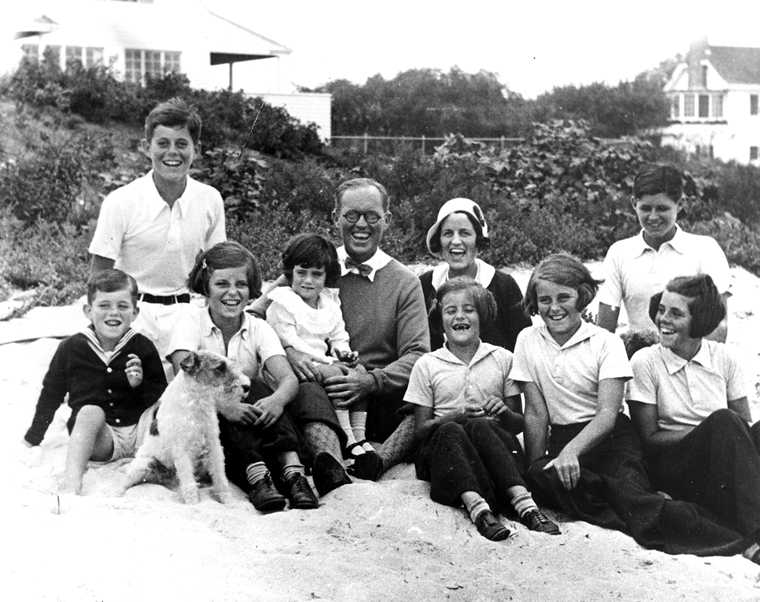
Answer: Joseph P. Kennedy, Jr.
File:TheKennedyFamily1.jpg
Part of the Kennedy family in 1931. In the background, left, is Jack, the 35th President of the United States. Teddy Kennedy was unable to make it for this photo, what with not having been born yet.


(Also for Three Word Wednesday and ABC Wednesday: "E" is for "explosion") 
This week’s quiz is about a hero of World War II and this week’s question is, what was his name?

During that war the Nazis came up with some nastily creative thinking as far as weapons against Britain were concerned.  Usually they thought about rockets and such, but one interesting weapon was just a gun, a supergun.

 File:Bundesarchiv Bild 146-1981-147-30A, Hochdruckpumpe V-3.jpg
It was a very long, very effective cannon.  It rested on this unkempt frame inside an inclined tunnel near Calais.  The weapon just sat there; it never moved and it would launch cruel explosive projectiles across the English Channel that landed on London to ghastly effect, and it could do all this with impunity.

You see, Allied bombers, try as they might, could not bomb it.  The tunnel was located inside deep rock.

So the Allied types came up with some creative thinking of their own. 


In a top-secret, and very dangerous, mission (“Operation Aphrodite”) they loaded up a huge bomber, a Liberator, with 20,000 pounds of explosives.  They’d navigate this flying bomb until it was right on target for the entrance of the tunnel.  Then the pilot would lock in the auto pilot and bail out.  The plane would blow up the tunnel and the supergun within it.

A great plan, but…

What happened was a terrible tragedy.  Just before the pilot was to bail out, an electrical fault in the Liberator caused all that explosive material to detonate. 


In a tremendous explosion the plane and the pilot just disappeared.  Here’s his picture.  He had been an interesting naval lieutenant, still in his twenties.  Interesting because he came from a well-known New England family, the eldest of nine children, and he had had a charmed life up to that time.  His family had sent him to Choate and Harvard and had plans for the young man to become an important figure on the American political scene.
His father, a former Ambassador, had been convinced that ultimately he could become President of the United States.


Sunday, February 2, 2014

205 Quiz Answer


Here’s the answer: A Chorus Line is a musical with music by Marvin Hamlisch that centered on dancers auditioning for spots on a chorus line.  The original Broadway production ran for 6,137 performances, becoming then the longest-running production in Broadway history.


(Also for Three Word Wednesday and ABC Wednesday: "D" is for "Dan")
Here’s this week’s Berownial quiz question.  I wrote the following scenelet, thinking it might remind you of a well-known musical.  Name the musical.

“Dan – you’re here?  I thought you had a job.”

“‘Had’ is right; past tense.  I haven’t worked for weeks.  I heard a job was available here so I thought I’d better show up.”

“It’s not just a job.  There are eight spots open, so that explains the crowd.” 

“Right.  I never saw so many people for a job interview.  The line extends out onto the sidewalk.”

“Well, if they’re looking for eight folks, that means I may have a chance.  I really need this job.”

“Tell me about it.  I haven’t paid my rent for a couple of months.  You know Len Crain?  He’s the rogue doing the hiring.”

“Crain?  Oh god, now I know I’m not gonna make it.”

“Why?  You had problems with him in the past?”

“Yeah.  I ran into him a few times.  He just don’t like the way I look, or something.  I don’t know what he expects.  Should I come on real strong, accelerate and show I’m a takeover guy, real capable, or should I play it like more passive, more submissive – yes, Mr. Crain, you’re right, Mr. Crain.”

“I don’t know what to recommend.  I just hope the two of us don’t wind up in competition for the same spot.”

“Well, with eight jobs available, we’ve both got a shot.”

“Tell me, you ever consider getting out of this rat race, going into some other line of work?”

“Ha.  I’ve been in quite a few other lines of work.  From Burger King to Wendy’s.  No, seriously, this is what I should be doing.  I remember way back when I was five or so I saw this on tv and before I even knew for sure what it was I said – I can do that!”


Blog designed by Blogger Boutique using Christy Skagg's "A Little Bit of That" kit.