Showing posts with label William Shakespeare. Show all posts

Sunday, October 7, 2012

Berowne's 138

(For Three-Word Wednesday and ABC Wednesday: "M" is for Mary Arden)
The prompt this week is of a sick woman.
I began sifting through my rather limited cranial capacity, trying to think of a historical character who would be appropriate for such a topic.
Then I thought of Will Shakespeare’s mother. In the year 1583 she was miserable because she was sick, but she was sick with worry, with fear.
And she had good reason.
It seemed quite possible that she was going to be charged as an accessory to an attempted assassination of Queen Elizabeth.
Let’s go back a bit.
As a teenager, it would have seemed that Mary Arden could have had her pick of the young fellows of her town for marriage; she came from a respected home, her father was a prosperous land-owner and she had an impressive dowry.
Yet many of that time were puzzled that the person she chose was not much more than a peasant. His background had been that he was barely (if at all) literate; he had had no money, no education, and a job of working in her father’s fields. His name was John Shakespeare.
But you see, Mary Arden was one of eight daughters, the youngest of the eight. For eight daughters there weren’t all that many eligible bachelors available in that area. She settled for John.
John S.’s story is amazing – from illiterate sharecropper he had a brisk rise to mayor of the town of Stratford – but that’s for a different post. We’ll concentrate on his wife, Mary.
But first let’s do a smooth segue to the story of another woman of that era, Queen Elizabeth I.
She was in mortal danger. When? Every day of her life, from the moment she was born. Every day that she was alive there were thousands of people who were dedicated to her assassination. She was Protestantism personified; Catholics in various parts of the world believed that England should return to the old religion and they were told they would be blessed if they killed her.
By the year 1583 the Queen had built up a remarkable collection of organizations that existed to prevent that assassination; she had spies and her own Secret Service, CIA and FBI.
Another smooth segue and we come to the story of Margaret Arden, a dear cousin of Will Shakespeare’s mom.
Encouraged by a local priest, Margaret Arden and her husband had made the mistake of becoming involved with him in a plot to shoot Queen Elizabeth. They were all arrested and taken to London.
Anyone who planned such an act, or even knew about it, was punished. The punishment was severe. The men were hanged, drawn and quartered and Margaret was burned at the stake.
Suspicion shifted to Stratford and a key part of the investigation had to do with Mary Arden Shakespeare; had she known about this plot? For quite a while she, and her family, were in extreme peril.
The Queen’s chief investigator, her J Edgar Hoover, was Francis Walsingham. He sent word to his subordinates up in Stratford that more guilty folks must be found and the way to determine if they were guilty was through torture.
Well, ultimately, things more or less blew over. Mary stayed alive, as did her family. However, Stratford was a dangerous place for a young guy whose family was under suspicion; Will Shakespeare detached himsself from the whole situation. He set up a strategic retreat, leaving town and heading for London.
(Also submitted to Sunday Scribblings)

Sunday, April 8, 2012

For Three-Word Wednesday, Magpie 112 and ABC Wednesday


("M" is for "Marriage in Shakespeare's day")
The prompt this week got me to thinking about Kate.
You remember Kate, the shrew?
In Shakespeare’s play, “The Taming of the Shrew,” we are introduced to a young woman who was difficult – no, not difficult; impossible.
But if ever a female had a right to be, er, shrewish, it was a girl of that Elizabethan age.
In this play Will Shakespeare shines a light on the condition of women of his time. A girl of respectable family was raised to get married. There wasn’t much else for her. She usually had no education; she never got to go to school.
If she was bright, intelligent, witty, these would be handicaps she would be expected to try to overcome.
No wonder Kate wasn’t all that enthusiastic about marriage. It was often no treat. She would probably have agreed with Cher, who said: “Marriage is a wonderful institution, but who wants to spend their life in an institution?”
Shakespeare created a character like the girl in this week’s prompt: it’s Kate trying to break out of the egg – the traditions, conventions, of that era - that held her back.
And she knew that marriage in those days, even if she did finally get around to accepting it, wasn’t all that great. A married woman was owned by her husband. And not just her person; everything she had was his too.
In “The Merchant of Venice,” the beautiful Portia is a young woman of great wealth. She is, not to put too fine a point on it, loaded.
The day she marries, the piles of dough - what today we might call her financial portfolio - immediately becomes her husband’s and he will decide what to do with it.

To get back to Kate: she finally, inevitably, gets married. She locates a husband; Petruchio just picks her up and lugs her off. This, by the way, is usually played as comedy.
Once married, as I’m sure you know, she finally changes. What’s interesting is how drastically she changes.
In the last act, Kate has accepted the onerous restrictions of her marriage and assures us that she’s very happy. She's a picture of serenity; she has become a Stepford wife. She even gives advice to young brides.
“Thy husband is thy lord, thy life, thy keeper. Such duty as the subject owes the prince, even such a woman owes to her husband. I am ashamed that women are so simple. To offer war where they should kneel for peace. Or seek for rule, supremacy and sway, when they are bound to serve, love and obey.”
It’s too much; it’s unbelievable.
Many scholars feel – and I, no scholar, tend to agree – that Will Shakespeare wrote this draft of the play with tongue firmly ensconced in cheek. They would agree with modern productions of this play that have Kate delivering these lines in a kind of bitter, sardonic way, to make sure everyone in the audience will “get” what she really thinks of her situation.
(Also submitted to Sunday Scribblings.)

Sunday, March 11, 2012

Three-Word Wednesday, Magpie 108 and ABC Wednesday

"I" is for "Imagine"

Thousands of twelve-year-old students of English literature, from Mumbai to Singapore, stand ready, at the drop of whatever is called a hat in their language, to recite what may be the poet William Wordsworth’s most famous lines (and the weekly prompt, above, reminded me of them):
I wandered lonely as a cloud
That floats on high o'er vales and hills,
When all at once I saw a crowd,
A host of golden daffodils;
Beside the lake, beneath the trees,
Fluttering and dancing in the breeze.

I was one of those twelve-year-olds once, though I had never been to either Mumbai or Singapore, and in my quavering, piping voice, I could recite at least some of Wordsworth’s poetry as well as any other pre-teener.

I found the poet himself of interest. What exactly, I would occasionally ask myself, are his Wordsworth? :-)
He had famously once defined poetry as "the spontaneous overflow of powerful emotions recollected in tranquility.” He was blown away by the beauty of nature, by a kind of suspended reality, and by the reconciliation of man with his environment, which gives his work an elegant, slightly modern tinge.
But it seemed to me that, no matter how interested you might be in this chap who sort of launched the Romantic Age in English literature back in the late 1700s, the story of his sister is even more fascinating, and more baffling.

In my view, she, Dorothy Wordsworth and the conditions of her life, are a few of the main reasons why we have a feminist movement today.
From time to time, writers like Virginia Woolf have wondered what would have happened had Shakespeare had a wonderfully gifted sister, called Judith, let us say. Just imagine...
“Her brother Will had some wild-oats adventures as a youth and finally became a successful actor who lived at the hub of the universe, meeting everybody, knowing everybody, practicing his art on the boards, exercising his wit in the streets, and even getting access to the palace of the Queen.
“Meanwhile his extraordinarily gifted sister, let us suppose, remained at home. She was as adventurous, as imaginative, as agog to see the world as he was. But she was not sent to school. She had no chance of learning grammar and logic, let alone of reading Horace and Virgil. She picked up a book now and then, one of her brother's perhaps, and read a few pages. But then her parents came in and told her to mend the stockings or mind the stew and not moon about with books and papers.”
Will Shakespeare had no such sister. Will Wordsworth did.
His sister was a writer. Dorothy Wordsworth's works came to light a century or so after her death when literary critics began to re-examine women's role in literature.
But Dorothy had a negative view of her own works. She did not believe what she wrote should be published; that was for men, that was for her brother.
She literally lived for him. And with him. When William married Mary Hutchinson in 1802 Dorothy of course continued to live with them. There was nothing else she could do; she was thirty-one years old and in 1802 that was considered to be too old for marriage.
So everything she did, everything she wrote, was to support, to be of service to, her brother. She did not really exist away from him.
It’s interesting to speculate just how many gifted women writers there were a century or two ago – or three or four centuries ago - who were never given a chance to actually write, to express themselves, to publish their work.
(Also submitted to Sunday Scribblings.)

Sunday, December 4, 2011

For Three-Word Wednesday

(Also for ABC Wednesday and Magpie 94)
"U" is for "Unforgettable"

This week’s prompt illustrates beautifully how the custom of communal dining, which ideally should be a chance for people to come together to enjoy delicious food, good company and conversation, is so often merely the process known as eating.
A meal with others can be a communal event, a sharing of both time and space, something as old as the discovery of fire when presumably prehistoric types sat around the cave near the single heat source that was used to cook their food.
In other words, a shared meal can have meaning; a chance to strengthen bonds or perhaps get to know someone better. In this week’s prompt, possibly a hurried lunch, that meaning is lacking.
I suddenly remembered how important a meal was to one of William Shakespeare’s most unforgettable characters, Shylock.
You see, when it came to communal dining, Shylock was against it.
This was not just because the food the Christians of his city ate was different from his Jewish fare; it was because he would go only so far in his relations with them.
He is blunt about it. “I will buy with you, sell with you, talk with you, walk with you, but I will not eat with you.”
I think it’s quite possible that Will Shakespeare never met a Jew, which is a bit odd when you realize that he created possibly the most famous Jew in all of English literature. For centuries, Jewish characters had appeared in various types of productions as villains, existing in Elizabethan England only as stereotypes and evil, mythical figures. These stereotypes were the playwright’s source for his play.
So the general understanding of that time was that Jews, first and foremost, hated all Christians, and might go to great lengths, if given the opportunity, to do harm to them.

So Shylock, though seemingly a passive man, was actually a cruel and miserly figure, and this would have fitted the usual, sereotypical view of a Jew of that era. But Shakespeare created a character who was also a devoted family man, a person of intelligence, someone even with a sense of humor – and someone who was not afraid to raise his flag against perceived enemies. Shylock was, in short, a human being whose behavior was the result of decades of cruelty by Venetian citizens. Above, Shylock with his daughter, Jessica.
As you undoubtedly know, in the play, during the famous trial sequence, Shylock is stymied when he tries to cut his pound of flesh from Antonio. The beautiful Portia, the play’s heroine, transmogrified into a lawyer, plays her ace: the contract didn't say anything about blood and it's against the law for a Christian's blood to be spilt.
As a result, because he had attempted murder, Shylock is stripped of all his wealth.
Then something interesting happens. The court, showing great magnanimity, will allow him to convert to Christianity.
No one of that time – and perhaps this was true of Shakespeare, too – seems to have realized that this great gift couldn’t have been regarded as such by Shylock.
He had lost his case, lost his fortune, even lost his daughter – who had married, to his disgrace, a Christian – and now he had nothing. He just wanted to get out of there.
“I pray you give me leave to go from hence,” he says. “I am not well.”


(By the way, I posted about Al Pacino’s “Merchant of Venice” a couple of months ago, but I thought I could refer to the play again because the character Shylock is one of Shakespeare’s most interesting, most complex and most challenging.)

Thursday, November 3, 2011

For Three-Word Wednesday and Sunday Scribblings

A few years ago a New York theatre critic wrote: “A snoozy Broadway season has been bolted wide awake by the arrival of a play drenched in juicy timeless issues -- racism, revenge and romance for dollars.”

“Forget that the work is 400 years old. The cause for cheers is the stirring version of ‘The Merchant of Venice,’ starring Al Pacino, a supernova you already know, as the moneylender Shylock.”

No matter what you think of Al Pacino playing Shakespeare, “Merchant” is a fascinating play. But what the play means is even more interesting.
After all, the plot is fairly well known. Shylock is a Jewish moneylender who lends dough to a Christian, Antonio, setting the security at a pound of Antonio’s flesh if the loan isn’t repaid on time.

Later Antonio, bankrupt, can’t pay back the loan so Shylock, acting like what we today might call an awful jerk, demands his pound of flesh. At the trial, the beautiful leading lady of the play, Portia, switches gender to play a “doctor of law” who tries to save Antonio’s life, arguing for mercy in a famous speech:
“The quality of mercy is not strain'd,
It droppeth as the gentle rain from heaven
Upon the place beneath. It is twice blest:
It blesseth him that gives and him that takes.”


Shylock, however, “wins” the case and gets set to collect his pound of flesh. But Portia, at the last minute, punctures his balloon; she points out that the contract only allows Shylock to remove the flesh, and not one drop of blood, so the carnage is avoided. Antonio’s life is saved and the money-lender is defeated.
(By the way, the actual “merchant” of Venice is Antonio, not Shylock.)
As I suggested, what the play “The Merchant of Venice” has meant to audiences throughout the past few centuries is kind of fascinating. Is it an anti-Semitic play? Does it reflect not only the general anti-Semitism of the Elizabethan age but Will Shakespeare’s own anti-Semitism?
Or is it Shakespeare’s plea for tolerance?
The history of the play’s productions is interesting. In some versions Shylock has been presented as a cruel caricature: heartless, hateful, greedy. In others, he is a more sympathetic character.
The Nazis, by the way, loved the play. At the beginning of World War II, “Merchant” was playing in numerous German cities. They changed it a bit: Shylock’s daughter, who was of course Jewish, did not marry a Christian, as Shakespeare had written.

A question that has often been asked is, what did Will Shakespeare feel about the character he created named Shylock? Will lived in a society – 16th-century England – that was, from our twenty-first century standpoint, almost incredibly anti-Semitic. So his Shylock was seemingly greedy and heartless, as his audiences would have expected, but it’s worth noting that the playwright created a character, the money-lender, who also had pride, energy, even a sense of humor. He could be seen as an omen, what happens to a person who is scarred by years of never-ending persecution and discrimination.
Shakespeare wrote some of his best-known lines for Shylock to deliver:
“Hath not a Jew eyes? Hath not a Jew hands, organs, senses, affections, passions? If you prick us, do we not bleed? If you poison us, do we not die? And if you wrong us, shall we not revenge? If we are like you in the rest, we will resemble you in that.”
An anti-Semitic play or a plea for tolerance? What’s your opinion?

Monday, July 4, 2011

For Magpie 72


Studying this week’s prompt, a few lines from Shakespeare’s “As You Like It” came back to me.

“It was a lover and his lass,
With a hey, and a ho, and a hey nonino,
Between the acres of the rye,
With a hey, and a ho, and a hey nonino
These pretty country folk would lie.

“This carol they began that hour,
With a hey, and a ho, and a hey nonino,
How that a life was but a flower
And therefore take the present time.
With a hey, and a ho, and a hey nonino.”

So the young country folk went out into the fields and – took the present time. What is so striking about the poem, and is suggested by Van Gogh’s painting, is that this seems to be the kind of field where the teenager named Shakespeare had carnival knowledge of his girl friend Anne Hathaway. :-)
But the light-hearted lines about young folk fooling around out in the fields signified something serious: Anne became pregnant and Will had to marry the girl.
So, a few years later, still a young man barely out of his teens, William Shakespeare found himself to be a solid pere-de-famille, a married man with three kids.
Had it been a forced wedding? Probably. The young lady would have been for it, but whether he liked the idea or not marriage was about the only option open to a decent young man of that time.
He may have been against getting hitched but, as James Joyce wrote:
“Shakespeare hath a Will,
But Anne Hathaway.”
:-)

Tuesday, May 10, 2011

(For Writer's Island, ABC Wednesday and Sunday Scribblings)
“Q” is for “Queen.”

As you may have heard, William Shakespeare was the top dog in the playwright trade.
And Elizabeth I was unsurpassed in the queen business.
So here’s something interesting.
Both Will and Liz lived in the same town, at the same time, and they knew each other. Thus a natural question would be, what kind of relationship did they have?
The answer appears to be, not much.
Queen Elizabeth was one of the greatest, and most powerful, sovereigns in the history of England.

Will Shakespeare, even though he may have been a genius, was a commoner. Sovereigns did not hang out with commoners.
Unlike today? :-)
But the Queen enjoyed the playwright’s plays and we can almost say that, without her, there would have been no Shakespeare.
It’s difficult for us today to understand the position of the theatre and theatre folk at that time. As you may know, in the seventeenth century a great many people let superstition govern their lives: there was a general belief in such things as witches, ghosts and omens. Another general belief on the part of many was that there was something "wrong" with the very idea of players and playhouses. Those in authority would have closed the theatres, torn them down, and forbidden anything except works of a religious nature - which was pretty well all that English drama had consisted of before the Shakespearean era.
There would have been no point in Will S. trying to fight local authorities; he would have had to surrender.
But they had a problem: Elizabeth.
She enjoyed plays as much as she loved music and dancing (she loved to dance). Whenever those in power tried to close down theatres, they were reminded that such an action would make the Queen unhappy. And they had learned early on that making the Queen unhappy was to be avoided, to say the least.

So William Shakespeare and his theatrical company flourished. They often performed before her at court. She so loved the character Falstaff in “Henry IV” that she let it be known to the playwright that she’d like to see him in another play. So Will S. sat down and speedily turned out “The Merry Wives of Windsor,” loading it with Falstaff and Falstaffian humor.
Elizabeth was gifted in a number of areas, but her knowledge of languages was amazing. She spoke English and Latin with equal fluency, Italian almost as well, and had a fair knowledge of French, Spanish and Greek. Since Latin was the language of diplomacy at that time, she could converse fluently with diplomats visiting England from just about anywhere, even if they spoke no English.
There’s a wonderful story – I’d like to think it’s true – that the Queen had invited the Russian ambassador and his entourage at court to see a Shakespeare play. As the actors performed, she kept up a running translation, in Latin, of what was going on.

Monday, April 4, 2011

Magpie 60

This week’s Magpie prompt got me to thinking of Feste.

In Shakespeare’s play “Twelfth Night,” there’s a jester of that name who sings, dances, plays instruments, tells jokes, etc. His most famous song is about rain.
“When that I was and a little tiny boy,
With hey, ho, the wind and the rain…”
Feste is attached to the household of the Countess Olivia. In those days, if you had a lot of money – and Olivia did – you had a permanent staff to provide entertainment. The television programs of the Elizabethan era were fairly primitive, to say the least, so after the evening meal all hands would sit back and enjoy whatever the staff tummlers could come up with in the way of amusement and distraction. The master – in this case the mistress – of the house would usually have a jester, fool, clown, whatever, on permanent call.
It was a tough gig. One wisecrack too many, one step over whatever imaginary line had been set up, and the joker would be out on the street. And he had to be prepared, no matter how he felt at the moment, to be funny.
“Here’s a man of jollity,
Jibe, joke, jollify!
Give us of your quality,
Come, Fool, follify!”

It’s understandable that the Jester of that era, a chap seemingly of such a playful and frivolous nature, occasionally had his moments of melancholy. Many artists, writers, operatic composers (“Rigoletto,” anyone?) have used this theme in their works.
And Will S. was no exception.
With all of Feste’s amusing shaggy-dog stories and pranks, the play’s audience realizes that there’s a darker and mysterious side to him. When he sings the famous line “The rain it raineth every day,” he’s saying that every day can bring some kind of misery. At the end of the play he sums it all up in a famous closing song:
“When that I was and a little tiny boy,
With hey, ho, the wind and the rain.
The rain it raineth every day.
But when I came to man's estate,
With hey, ho, the wind and the rain,
'Gainst knaves and thieves men shut their gate,
For the rain, it raineth every day.”

He then comes right out and in effect makes a plea for applause:
“A great while ago the world begun,
With hey, ho, the wind and the rain.
But that's all one, our play is done,
And we'll strive to please you every day.”

Wednesday, February 2, 2011

For "Writer's Island" and "Story"


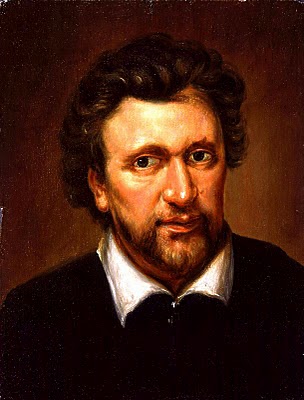
Surely there's a place this week for the story of one of the great writers -- poet, playwright -- in the history of our English literture: Ben Jonson.
To many scholars, he was the greatest dramatic genius of the Elizabethan theatre, after Shakespeare.
He is best known for his satirical plays and his lyric poems. He was a man of vast reading and a seemingly insatiable appetite for getting into trouble.

What makes him interesting is this: he started out as a bricklayer.
Like most bricklayers of 400 years ago he was unable to go to university, so he decided to educate himself. He became one of the best-educated men in the country.

Ultimately, Oxford, which previously wouldn’t have allowed him to so much as deliver a pizza to the back door, granted him an MA.
He was also contentious and very argumentative. His story consisted of a rap sheet that was almost unbelievable. He had killed a soldier in man-to-man combat in the Low Countries, and he killed another man in a duel. He was locked up in prison from time to time for “leude and mutynous” behavior, which seemed to sort of sum up his life.
It’s worth pointing out that the report of his heroic man-to-man combat experience while he was in the army came from him; no one else ever mentioned it.
As for the duel, that actually happened, and Ben J. was in trouble; he could have been hanged for such a killing. He managed to get off by using a legal ploy, something that says a lot about Elizabethan life. He got off by pleading “benefit of clergy.”
It worked, even though there were few who would have described Ben Jonson as clergy, or even having much to do with clergy.
However, there were so few educated people in England at that time that authorities decided it would be best not to execute a person if he could prove he could read and write. In that case he would be considered to be “clergy.” Ben did well in this test: he aced the exam by reciting a Bible verse in Latin. He got off lightly: he was just branded with the mark of a felon.
This tough guy was capable of magnificent writing; how many bricklayers do you know who could beguile the reader with a poem as light and lovely as “Drink to Me Only With Thine Eyes,” which he did.
As for the profession of playwrighting, it was at that time a dangerous business. Write the wrong words in a script and your punishment could be severe. In Ben Jonson’s play “Eastward Ho!” he committed the fox pass of appearing to suggest that King James the One had accepted payment for creating knighthoods. That was a mistake. He not only wound up in jail but endured torture. Will Shakespeare was careful throughout his career to keep his nasal passages clean; he stayed out of trouble. Ben sort of stayed in trouble.

As an example of what could happen, the playwright Thomas Nashe wrote a play titled “The Isle of Dogs,” which the Privy Council did not, to say the least, like very much. Aware of the possible impending imprisonment and torture – everyone was aware that the horrible rack, among other such devices, could be waiting for them – Nashe hurriedly left town and hid out in the country. The Privy Council threatened to tear down all the theatres. That would have brought the Golden Age of Theatre to a grinding halt, not to mention Will Shakespeare’s career along with it. Fortunately, the Council never got around to actually carrying out its threat.
If Ben Jonson were around today, my guess is he would be a writer of plays for off-off-Broadway, and he would usually be dressed, even for formal occasions, in worn-out jeans and a dirty T-shirt with an offensive motto printed on the front, and he would be sporting a huge bushy beard, with bits of whatever he had for breakfast embedded in it.

Ben Jonson was William Shakespeare’s friend/competitor/nag and general pain in the neck. He regarded with amusement his pal Will’s efforts to turn himself into a gentleman. It would seem he especially got a kick out of the Shakespeare coat of arms, with its “Not Without Right” motto. We know this because Jonson proceeded to write a play that features a character who has received a coat of arms (which he got through bribery); the character, by the way, is a clown.
His coat of arms has a picture of a boar, with a three-word motto beneath: “Not Without Mustard.”
Everyone who was in any way connected with the theatre in London at that time undoubtedly found that hysterically funny. It’s probable that Our Will wasn’t as amused.

As a totally irrelevant side comment, Pocahontas – yes that Pocahontas – was in England and was actually in the audience for one of Ben’s productions.
Ben Jonson died on Aug. 6, 1637. His story ends in this way: once he was safely dead, the country decided that he was the foremost man of letters of his age and he was buried with great ceremony in Westminster Abbey.
(He was one up on his friend Will; Shakespeare was not buried in Westminster Abbey.)

Ben was buried under a slab on which was carved the words, “O Rare Ben Jonson!”
He was rare; there were none rarer.

Tuesday, December 28, 2010

For ABC WEDNESDAY

"X” is for “Extraordinary”
[I cheated a little – the word doesn’t actually begin with “X.” :-)]
This is the story of an extraordinary play. Authors of most dramatic works ask their audiences for what is known in the trade as a “suspension of disbelief.” They say, in other words, “Try to believe that what I’m telling you actually happened – or could have happened.”
But with this play, Will Shakespeare doesn’t expect you to believe a word. Because the plot isn’t just extraordinary; it’s actually kind of nutty.
Yes, the creator of the greatest, most searingly powerful dramas ever written – like “King Lear,” “Macbeth,” “Hamlet” and “Othello” – was capable of kicking back and just having a bit of fun.

The bit of fun Our Will came up with is titled “The Comedy of Errors.” It’s as though he cooked up a holiday pudding and stuffed it with puns, slapstick, wordplay, mistaken identities, and any other wildly farcical device he could think of.
Check out this story.
The “hero,” if that is the word I want, is named Antipholus. Quite an ordinary name, wouldn’t you say? I’m sure you have a number of friends named Antipholus, as who among us hasn’t?
Well, this guy has a twin brother named – also – Antipholus. Again, nothing unusual about this. Just another case of twins both named Antipholus.

Well, the first Antipholus has a servant named Dromio. Here things begin to get a little odd, because the second brother also has a servant who is also named Dromio, and who is a twin brother of the first servant.
Are you with me so far?
So you have two chaps who look exactly alike and with the same name, served by a couple of servants who also look exactly alike and with the same name.
The only way we can tell the twin leading characters apart is if we call them “Antipholus of Syracuse,” because that’s where he’s from, and “Antipholus of Ephesus,” because that’s where he lives.

Well, long story short, the Syracuse guy shows up in Ephesus looking for his bro, whom he hasn’t seen in many years. He sends his servant to deposit some of his money for safekeeping. Later the other servant named Dromio shows up and, thinking it’s his boss, tells him to come home to dinner since his wife is waiting for him.
The Syracuse guy thinks his servant is playing a joke on him, so he whacks the fellow upside the head a couple of times, which is what one did with servants in those days. Things are made worse when he asks Dromio about the money he was supposed to have deposited and the servant claims to know nothing about it.
There are fine scenes where Antipholus of Syracuse has a great time going “home” and having dinner with a woman who believes she is his wife. And his servant Dromio of Syracuse learns that he too has a wife in Ephesus, a kitchen-maid who is a rather large woman, to put it mildly.
He describes her as "spherical, like a globe; I could find out countries in her buttocks." He claims he has discovered America "upon her nose all o'er embellished with carbuncles.” (This, by the way, was the first reference by Shakespeare of America.)

Things get wild and crazy as the plot develops. Les freres Marx never made a film of this one, but they should have.
If you’d like to get the whole story of the play, including how the “right” Antipholus arrives home to have dinner with his wife and finds himself locked out – while his lady is in there doing God knows what with some other man – along with a wide variety of other ludicrous deeds, exploits and situations, read the play. Or better yet, see it. There was a wild, far-out version done by the Flying Karamazov Brothers that is truly hilarious.
That’s “The Comedy of Errors,” Will Shakespeare as gag-writer. :-)

Tuesday, December 14, 2010

For ABC WEDNESDAY

“V” is for “Virago”
Dictionary: “A noisy, domineering woman; a shrew.”

As you probably know, Will Shakespeare wrote a play titled “The Taming of the Shrew.”
It’s strange that a work like this has been performed so often in our time; the feminist revolution of the past century or so would seem to have rendered portions of the play – shall we say, unpalatable? – for today’s audiences. But there have been plenty of staged productions, as well as Broadway musicals and major motion pictures (“Kiss Me Kate,” for example).
Here’s the story. Kate is angry. She has quite a bit to be angry about. She’s the eldest daughter, but she feels she has always been treated as second-rate while her younger sister, Bianca – who is regarded as more beautiful as well as “nicer” – receives attention and admiration from everyone. So Kate has become sharp-tongued and quick-tempered and has been known to throw stuff about during a tantrum.
The father, Baptista, had the problem all fathers of that era had: he must find suitable husbands for his daughters. He felt that it was important that Kate, the eldest, be married first, but of course the problem was that any potential suitor who got to know Kate took off as soon as he could and was not seen again.
So Baptista’s rule was, no one could court (or marry) Bianca until Kate was married.
That’s the situation when our hero, Petruchio, arrives in town, openly planning to get married, assuming he can find a reasonably attractive female who also has a hefty dowry.
Well, Kate fits that description, but locals warn him that the girl is impossible. But Petruchio, who can be as loud, boisterous and eccentric as Baptista’s oldest daughter, disregards everyone who warns him of her shrewishness.

When he goes to Baptista’s house to meet Kate, they have a tremendous duel of words. (Above, the Elizabeth Taylor-Richard Burton version.) Katherine insults Petruchio repeatedly, but he tells her that he is going to marry her whether she agrees or not. Hearing this claim, Kate is strangely silent, so the wedding is set.
One gets the feeling that Katherine really has a deep-seated sense of insecurity, which is probably the cause of her shrewishness, and that she actually rather likes the idea of marrying this brash young man.

Petruchio does all kinds of wild stuff to prove he’s the boss. He shows up at the wedding under the alfluence of inkohol while wearing outlandish clothes, and he plays tricks on his new wife. Today’s audiences tend to feel a bit uncomfortable during all this; it is clearly abusive behavior.
But it’s the final sequence that is the hardest to take. Petruchio has succeeded in taming the shrew. His wife has changed greatly; she has become passive and submissive. When he orders her to drop what she’s doing and come to him, she replies:

“What is’t your honour will command wherein your lady and your humble wife may show her duty and make known her love?”
Petruchio replies: “Kiss me, Kate, since thou art become so prudent, kind and dutiful a wife.”
So we are left with a question. Is the play titled “The Taming of the Shrew” an indication of what William Shakespeare thought an ideal wife should be to have a good marriage? Or is the play actually his attack on the hypocrisy of the customs and practices of his time?
Your opinion?

Wednesday, December 8, 2010

Magpie 44


This week’s prompt of a sled immediately brought to mind a strange, curious passage in the play “Hamlet.”
Hamlet’s dad, the late King, is of course dead as the play begins. However, he has returned as a ghost to encourage his son to seek vengeance for his murder.
Problem is, young Hamlet, who has not as yet seen the spirit, can’t be sure that the phantom is really his late father.
His friend Horatio, however, has seen it, and is convinced it is the ghost of the late King. He was on the guard-platform of the castle when it appeared.
Sentinel: “Is it not like the King?”
Horatio: “As thou art to thyself. Such was the very armor he had on when he the ambitious King of Norway combated.”

Horatio: “And so frowned he once when in an angry parley he smote the sledded Polacks on the ice.”
According to the text, the late King had been in various battles – more or less something to be expected from a king – and was involved in a fracas with some Polish guys who were on a sled. The Elizabethans used what for us today is a politically incorrect term, “Polacks,” for Polish people, but it was the 16th century and they knew no better. :-)
In other words, the way the old King had looked during this battle on the ice, this skirmish on sleds, is exactly how he looked when he showed up at the castle as a spirit. So the ghost must be legit.

Whether he is an authentic phantom or some evil spirit just pretending to be the late King is a key problem, which Hamlet spends a lot of time trying to figure out.

Tuesday, December 7, 2010

For ABC WEDNESDAY

“U” is for “Unbelievable”
If you’re a student of history, you probably know about the Seven Years War – known to us Yankees as the French and Indian War.

And maybe you’ve heard of the Hundred Years War.
Well, today I’d like you to consider a different war, one that has gone on for at least two hundred years.

It’s the war between those who believe that William Shakespeare wrote the Shakespeare plays…
And those who say nope, it was somebody else.


It has even been claimed that it was Elizabeth the One who was the real playwright. After all, she didn’t have much else to do so she wrote thirty-eight plays. :-)
I’ve always found this an interesting subject because the anti-Shakespeare types present such a seemingly powerful case, yet the majority of the best-qualified scholars are convinced that it was indeed our boy Will who was the real playwright.
First off, let’s define our terms. People who believe that the playwright was Shakespeare are known as “Stratfordians,” because Will S. was born and raised in Stratford; those opposed to this belief are “Anti-Stratfordians.”
Now that we have that out of the way, let’s examine, first, the anti-Stratfordian argument: William Shakespeare could not have written the Shakespeare plays. Period.

Why not? Because Will was a humble bumpkin from a humble country town whose original humble position on the Elizabethan social totem pole was very close to the bottom.
This low-born country hick could not possibly have known how kings and dukes, not to mention earls, thought, spoke and acted. And the plays in question are of course chock-full of such eminent personages.
In addition, the real playwright knew Latin as well as some Greek, and had a working knowledge of French and Italian. Some kid from Stratford, whose father made gloves for a living, could know all this?
In searching about for the real writer of the plays, the “anti” types came up with a winner: Edward de Vere, the 17th Earl of Oxford.

Eddie de Vere was the perfect candidate; he had it all. Born and raised an aristocrat, he knew exactly how the royals, not to mention the nobles, talked and acted. And he was a writer. So the theory is that he wrote the plays but it would have been an embarrassment for someone in his position to acknowledge this, so it was given out that it was a fairly unimportant actor, guy name of Will Shakespeare, who was the author.
As you can see, the antis base most of their argument on class. Will was too low-class; de Vere was very high-class.
But when you examine this topic carefully, some interesting facts emerge. Eddie de Vere died in 1604, which is before about a third of the Shakespeare plays had even been written.
Shakespeare was indeed an actor, probably a good one. An actor then could act royalty, or any other high-born type, better than could a king himself. That’s true today too, of course; the greatest actors – Olivier, Gielgud, Branagh; the list goes on – were not born aristocrats, but any of them could “do” kings better than any of the actual sovereigns.

Will S.went to a school in Stratford that was one of the best schools of its type in the country. He got a remarkable education. The classes were conducted in Latin and the kids studied the great playwrights of ancient Rome and Greece. In addition, Shakespeare was perfectly capable of further educating himself in many different fields – the guy was a genius, after all.
Surely the members of Shakespeare’s theatrical company, over a period of some twenty years, would have known if their colleague Will had not been the real writer of the thirty-eight plays, but there was never one word, not one hint – ever – from anyone of that entire theatrical world as to such a possibility.

My belief, as a card-carrying Stratfordian, is that Our Will wrote the plays. I base this on a room-full of convincing facts, including a most important point: in spite of the large number of claims the antis advance, they offer nothing – not one single shred of solid, written evidence – to support their arguments. Their theories are, as the title of this post suggests, unbelievable.
 
Blog designed by Blogger Boutique using Christy Skagg's "A Little Bit of That" kit.