Showing posts with label punctuation. Show all posts

Tuesday, September 13, 2011

For Sunday Scribblings

(Also submitted to Three-Word Wednesday and ABC Wednesday.)
“I” is for “Its”

I recently learned that I seem to be suffering from a terrible illness: Punctuational snobbery.
You see, years ago I learned – (I’m not sure how I learned it, but I learned it) – when to use “its” and when to use “it’s.”
So now whenever I see the writing of someone who is still in the dark its-wise, who obviously has no idea when “its” is right and “it’s” is wrong, I’m embarrassed to find that I sort of look down on that unfortunate character, as I would if at an elegant dinner party he was a guy who ate peas with a spoon.
After all, a person can be a fine, upstanding individual, a credit to his community, kind to his mother and good to his dad, and still not grasp the grammatical niceties. So smug punctuational snobs have no right to look down on him.
Somehow, however, even if only a tiny bit, we do. It’s – (there, I just used it) – it’s as though we want to whisper to him: “The fork, buddy, use the fork for peas.”
But you can get the thing right with ease, because the rule is easy:
You use an apostrophe with “it’s” when it is a contraction for “it is” or “it has.” Examples: “It’s a nice day” or “It’s been great getting to know you.”
Otherwise, run with an omission of the apostrophe and write “its”; you can’t go too far wrong.
Punctuation shouldn’t be all-important; there should be no punctuational snobbery, discrimination of a person because he/she is a bit -- punctuationally backward, shall we say? :-)
It’s – (that thing again) – it’s as though we look down on a person at a job interview because he shows up wearing socks of different colors. Shouldn’t really matter, after all.

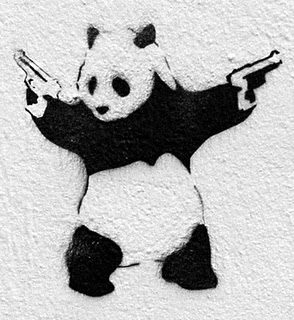
You know the famous panda story, the one about the murderous gun-toting panda? Seems a wildlife book had described the panda as a “large black-and-white bear-like mammal, native to China. Eats, shoots and leaves.” Just a misplaced comma, but it turned the peaceful panda into a wild gunslinger.

As you may be aware, Lynne Truss wrote a book about him, a book subtitled “the zero-tolerance approach to punctuation,” and it was a huge best-seller.
It’s – (there it is again) – it’s a fact that for a while she made punctuation popular. :-)
Tuesday, August 17, 2010

For ABC WEDNESDAY

"E" is for "English"
The English language, to be precise.

I guess it’s a sign that I’m getting on in years, but I miss the old grammar rules.
I always thought it was easy to determine the intelligence and education, not to mention the acumen and taste, of various people simply by reading what they wrote and how they wrote it.
If they showed they didn’t know basic English grammar -- when to use “it’s” and when to use “its,” for example – I thought I had them pretty well figured out as people, even though I had never met them.
But all this has changed. Seated at my computer and logged on to the web, I can see, along with everyone else, that an entirely new language is being created.

Thanks to younger folks, and not us old codgers, it’s a strange dialect, presumably based on English, which has taken over, and it pays no obeisance to, or even recognizes, rules of grammar, punctuation and spelling. In addition, it relies heavily on acronyms.
BRB, OMG, TTYL, LOL, BTW, CU, as examples.
And yet, the folks who write using this stripped-down texting patois seem to be able to communicate more or less effectively with their chat friends.

But surely punctuation, to take just one example, is important. You know the famous panda story, the one about the murderous gun-toting panda? Seems a wildlife book had described this creature as a “large black-and-white bear-like mammal, native to China. Eats, shoots and leaves.” Just a misplaced comma, but it turned the peaceful panda into a wild gunslinger.

As I’m sure you’re aware, Lynne Truss wrote a book about him, a book subtitled “the zero-tolerance approach to punctuation,” and it was a huge best-seller. I thought it might make punctuation popular. But maybe not.
During my pedagogical years I was at times dismayed to find that such usages as “IIRC” and “IMO” were occasionally used by students writing their papers. So are acronyms and emoticons, accompanied by a total lack of rules of English grammar, simply a short-term, ephemeral phenomenon, specific to internet communication, or does all this represent the real future of our written English language?
(By the way, scientific research has established that “ACRONYM” stands for “A Crazy Reminder of Names You Misplaced.”)
Question is, is this where our language is headed? Will this rough-hewn internet argot become Standard English one of these days? What’s your opinion?

Saturday, August 29, 2009

ENGLISH GRAMMAR: ITS VS. IT'S

I guess it’s a sign that I’m getting on in years, but I miss the old grammar rules.

I always thought it was easy to determine the intelligence and education, not to mention the acumen and taste, of various people simply by reading what they wrote and how they wrote it.

If they showed they didn’t know basic English grammar -- when to use “it’s” and when to use “its,” for example (see above title) – I thought I had them pretty well figured out as people, even though I had never met them.

But all this has changed. Seated at my ‘pewter and logged on to the web, I can see that an entirely new language is being created. It’s a strange dialect, presumably based on English, which has taken over, and it pays no obeisance to, or even recognizes, rules of grammar, punctuation and spelling, not to mention capitalization or other outworn concepts. In addition, it relies heavily on acronyms and emoticons.

And yet, the internet folks often seem quite intelligent and manage to communicate very effectively using this new vernacular with their chat friends.

During my pedagogical years I was at times dismayed to find that such usages as “IIRC” and “IMO,” among others, were occasionally used by students writing their term papers. (No one used an emoticon, however, I’m pleased to add.) So are acronyms and emoticons, accompanied by a total lack of rules of English grammar, simply a short-term, ephemeral phenomenon, specific to internet communication, or does all this represent the real future of our written English language?

By the way, scientific research has established that “ACRONYM” stands for “A Crazy Reminder of Names You Misplaced.”

Question is, is this where our language is headed? Will this rough-hewn, stripped-down internet argot become Standard English one of these days? What’s your opinion?
 
Blog designed by Blogger Boutique using Christy Skagg's "A Little Bit of That" kit.