Sunday, November 13, 2011

For Three-Word Wednesday and Sunday Scribblings

(Also for ABC Wednesday and Magpie 91)
"R" is for "Revolutionary"

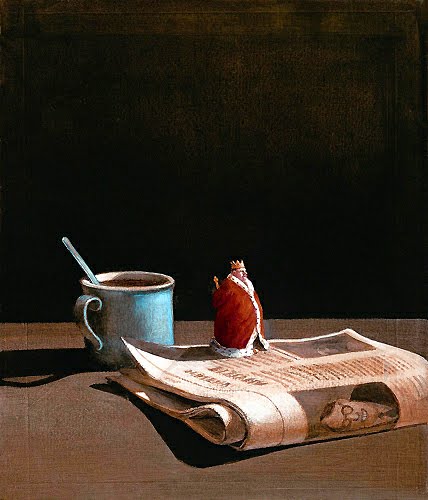
The prompt this week struck me with force. It’s as though it could easily serve as illustration of a famous event that happened on one hot July day in Russia back in 1918.
The girl stares about her, unable to comprehend the enormity of an incredible catastrophe. The empty chairs represent the members of her family, all slaughtered by revolutionary Bolsheviks. She alone survived.
For me, this provided the impetus to write the following story. Since it was posted almost two years ago, I thought folks might not mind if I submitted it again. Here ‘tis…


Victor
: I’ve told you before, I don’t like doing this.
Mike: I know, but this is something special. I really need your help. An expert like you can tell me if this thing is worth real money. If so, well, there’s a big chunk of dough in it for you.
Victor: All right, let me have a look at it.

Mike: There. What do you think? Somethin’, isn’t it? Go ahead, take your time, no hurry. Look it over good.
Victor: I don’t need to look it over. I know exactly what it is.
Mike: You do? You mean it’s famous?
Victor: You could say that. How did you get this?
Mike: There are two young men who sort of work for me. They – er – acquired it.
Victor: You’re a fence, aren’t you, Mike? And the two young men are punks who steal stuff for you, right?
Mike: Now, wait a minute. How they got it or how it got here isn’t the question. All I want to know from you is, what’s it worth?
Victor: What did you pay for it?
Mike: Well, I figured I could always sell it for fifty dollars – a hundred if I’m lucky. So I gave them thirty-five bucks for it.
Victor: Thirty-five bucks. Unbelievable…
Mike: It’s worth more? A lot more?
Victor: To you it’s worth nothing. You wasted your thirty-five bucks.
Mike: What are you trying to pull? It’s gotta be worth something.

Victor: Let me give you a bit of history. Way back in 1918, the Russian royal family, the Romanoffs, may have begun the year thinking they were firmly established as rulers of Russia. But that year they were brutally voted out: the entire family was assassinated by revolutionary Bolshevik secret police. You’ve heard about this?
Mike: Sort of.

Victor: Then maybe you also heard that one of the daughters, Anastasia, managed to live through the assassination attempt and escaped. She later lived in Europe for years under the name of Anna Anderson. The word got around in recent years that she had moved to the States and spent the rest of her life here. Nobody could verify this; instead of seeking vindication, all she wanted was to avoid all publicity.
Mike: And this thing belonged to her?
Victor: You guessed it. She had this magnificent ceremonial Easter egg with her at all times as a kind of solace, and it was the only thing she had been able to save.
Mike: And you’re trying to tell me it isn’t worth anything?

Victor: It isn’t worth anything to you. That girl, just a teenager at the time of the assassination attempt, was a royal princess: the Grand Duchess Anastasia. If you could put this up for auction now I imagine the bidding would begin at around twenty million dollars.
Mike: Holy smoke!
Victor: But if you tried to sell it you’d have cops and FBI and Interpol and God knows who else after you. Your life would be in danger. And the law would learn a lot about your operations you’d just as soon they didn’t know.
Mike: You wouldn’t consider buying it, would you?
Victor: I would not. There’s never going to be anything but headaches with this. Way I see it, the person who owns it – or owned it before it was stolen from him – was keeping it very quiet, and probably for good reason.
Mike: So what am I supposed to do?
Victor: I’ll tell you what you should do. Pay the two hoodlums who stole this to carefully take it back to the home they stole it from. Leave it on the doorstep with a note saying “Easter egg. Happy Easter!”

Sunday, November 6, 2011

For Three-Word Wednesday and Sunday Scribblings

(Also for ABC Wednesday and Magpie 90)
“Q” is for “Quotation”

This week’s Magpie prompt reminded me of a Shakespeare play, one I’m sure you’re familiar with. And of course when I think of Shakespeare I think of quotations.
Before we get to the quotation in question, let me set the scene.

The story really begins with a huge ball, an elegant party Old Man Capulet throws because he’s going to marry off his daughter Juliet to a man he has chosen for her.

But there’s a hitch: Juliet falls in love with another, a chap named Romeo, a Montague who showed up at the party uninvited.
The Capulets hate the Montagues and have for many decades. (No one alive remembers the reason for this feud; it just keeps rolling along under its own power.)
As you might imagine, everyone drank too much at the party, which happens at quite a few parties, I am informed. Old Man Capulet feels that life is good. However, he isn’t aware that his daughter has not only fallen in love with this Romeo fellow but is actually married to him.
Juliet knows her dad is going to insist she marry the other man; she’s despondent, wants to end it all. However, she is given a secret potion that will simulate death but allow her to regain consciousness later, and then she and Romeo can, hopefully, go off and live together.
She musters up the courage to drink the potion. The Capulets are overcome with grief at the news of what they believe is their daughter’s death and she is interred in the family’s burial vault.
A message is sent to Romeo to make sure he understands that the potion Juliet has taken will allow her to recover consciousness later. Unfortunately, tragically, he does not receive the message; he believes that Juliet has died and her body is in her family’s vault.
When he arrives he delivers these powerful lines (and this is the quotation I had in mind):
“Here lies Juliet,
And her beauty makes this vault a feasting presence full of light.
O my love, O my wife,
Death, that has sucked the honey of thy breath,
Hath had no power yet upon thy beauty.
I will stay with thee,
And never from this palace of dim night
Depart again.”

Thursday, November 3, 2011

For Three-Word Wednesday and Sunday Scribblings

A few years ago a New York theatre critic wrote: “A snoozy Broadway season has been bolted wide awake by the arrival of a play drenched in juicy timeless issues -- racism, revenge and romance for dollars.”

“Forget that the work is 400 years old. The cause for cheers is the stirring version of ‘The Merchant of Venice,’ starring Al Pacino, a supernova you already know, as the moneylender Shylock.”

No matter what you think of Al Pacino playing Shakespeare, “Merchant” is a fascinating play. But what the play means is even more interesting.
After all, the plot is fairly well known. Shylock is a Jewish moneylender who lends dough to a Christian, Antonio, setting the security at a pound of Antonio’s flesh if the loan isn’t repaid on time.

Later Antonio, bankrupt, can’t pay back the loan so Shylock, acting like what we today might call an awful jerk, demands his pound of flesh. At the trial, the beautiful leading lady of the play, Portia, switches gender to play a “doctor of law” who tries to save Antonio’s life, arguing for mercy in a famous speech:
“The quality of mercy is not strain'd,
It droppeth as the gentle rain from heaven
Upon the place beneath. It is twice blest:
It blesseth him that gives and him that takes.”


Shylock, however, “wins” the case and gets set to collect his pound of flesh. But Portia, at the last minute, punctures his balloon; she points out that the contract only allows Shylock to remove the flesh, and not one drop of blood, so the carnage is avoided. Antonio’s life is saved and the money-lender is defeated.
(By the way, the actual “merchant” of Venice is Antonio, not Shylock.)
As I suggested, what the play “The Merchant of Venice” has meant to audiences throughout the past few centuries is kind of fascinating. Is it an anti-Semitic play? Does it reflect not only the general anti-Semitism of the Elizabethan age but Will Shakespeare’s own anti-Semitism?
Or is it Shakespeare’s plea for tolerance?
The history of the play’s productions is interesting. In some versions Shylock has been presented as a cruel caricature: heartless, hateful, greedy. In others, he is a more sympathetic character.
The Nazis, by the way, loved the play. At the beginning of World War II, “Merchant” was playing in numerous German cities. They changed it a bit: Shylock’s daughter, who was of course Jewish, did not marry a Christian, as Shakespeare had written.

A question that has often been asked is, what did Will Shakespeare feel about the character he created named Shylock? Will lived in a society – 16th-century England – that was, from our twenty-first century standpoint, almost incredibly anti-Semitic. So his Shylock was seemingly greedy and heartless, as his audiences would have expected, but it’s worth noting that the playwright created a character, the money-lender, who also had pride, energy, even a sense of humor. He could be seen as an omen, what happens to a person who is scarred by years of never-ending persecution and discrimination.
Shakespeare wrote some of his best-known lines for Shylock to deliver:
“Hath not a Jew eyes? Hath not a Jew hands, organs, senses, affections, passions? If you prick us, do we not bleed? If you poison us, do we not die? And if you wrong us, shall we not revenge? If we are like you in the rest, we will resemble you in that.”
An anti-Semitic play or a plea for tolerance? What’s your opinion?

Wednesday, October 26, 2011

For ABC Wednesday and Magpie 89

(Also for Three-Word Wednesday and Sunday Scribblings)
"P" is for Phone Conversation

I had sat at the typewriter for over an hour, trying to figure out what to write. (This happened back in the days before I got around to email.)
I had received an extraordinary letter. It was from a man up in Rhode Island, a man I had known in the old days.
It was a delicate matter; I had known him and also known his wife, back before they were married. I had known her, actually, rather well.
In his letter he said she had left him and he thought I might be able to help him find her. The problem of what to write was suddenly solved because the phone rang. Since he hadn’t received an answer to his letter he decided to call me directly. He got right to the point.
"Reason I wrote you, you went with her for a year or so back then, before we got married."
“A year or so? It was actually a few months. And ‘went with her’ isn’t really accurate; we were friends.”
“That ain’t what I heard.”
“So, well, anyway, how is Marilyn? Okay I hope.”
“Marilyn? You don’t even remember her name. It’s Maureen.”
“Oh, right. You know, it was a long time ago; I was just out of college. I don’t remember everyone I knew in those days.”
“Well, as I wrote you, she left. Just got up and left.”
“Yes, I was sorry to read that.”
“It got me upset; my whole family is upset. It even got her family upset. A married woman. My wife. Just up and leaves. Anyway, I thought you might help.”
“Sure, if I can.”
“Here’s the thing. If she should ever contact you – you know, call on the phone to talk over old times or whatever – could you tell her that what she really ought to do is go back to her husband. And then let me know where she’s staying. It’s important that I find out where she’s staying.”
“Why do you think she left?”
“Who knows? Maybe she just don’t like Rhode Island.”
“She told me, way back when she was first talking about getting married, that she felt vulnerable, that you weren’t – well – all that nice to her.”
“That’s baloney. If she said anything like that, it was a figment of her imagination. As her husband, I worked hard, fifty hours a week sometimes, to get her whatever she needed. You can’t be much nicer than that.”
“But, you never – I’m just trying to figure out why she left -- you never abused her, never hit her or anything like that?”
“What’re you -- a shrink or somethin’!? I didn’t call you to get a lecture! I’m a husband from the old school. My whole family, we know how to treat women.”
“Well, I’m sorry I can’t be of much help. But I'll go along with you in this operation; if I should ever hear from her, I’ll tell her to go back to her husband. Goodbye.”
I hung up the phone.
“Was that him?” she asked.
“Yes. I just hope he stays up there and doesn’t come down here to New York. As I remember, he was a pretty big guy. I’d be inclined to avoid a confrontation.”
“Yes, we’ve got to be careful. When I mentioned divorce, he said he’d kill me first.”
“And that would mean me second. I guess this is what they call living dangerously. But it’s worth it, Maureen – to have you with me again.”

Sunday, October 23, 2011

For ABC Wednesday

(Also for Magpie 88 and Sunday Scribblings)

O Mannahatta!
"I was asking for something specific and perfect for my city,
Whereupon lo! upsprang the aboriginal name:
Mannahatta!
Now I see what there is in a name, a word, liquid, sane, unruly,
musical, self-sufficient.
I see that the word of my city is that word from of old,
Because I see that word nested in an island sixteen miles long, solid-founded.
Numberless crowded streets, high growths of iron, slender, strong,
light, splendidly uprising toward clear skies.
The down-town streets, the jobbers' houses of business, the houses
of business of the ship-merchants and money-brokers, the
river-streets.
Immigrants arriving, fifteen or twenty thousand in a week.
The summer air, the bright sun shining, and the sailing clouds aloft.
The winter snows, the sleigh-bells, the broken ice in the river,
passing along up or down with the flood-tide or ebb-tide.
The mechanics of the city, the masters, well-form'd,
beautiful-faced, looking you straight in the eyes.
Trottoirs throng'd, vehicles, Broadway, the women, the shops and shows,
A million people--manners free and superb--open voices—-hospitality.
City of hurried and sparkling waters! City of spires and masts!
City nested in bays! Mannahatta, my city!"
Walt Whitman
(P. S. It's always been my backyard. --Berowne)

Sunday, October 16, 2011

For Three-Word Wednesday

(Also for Magpie 87, Sunday Scribblings and ABC Wednesday)
"N" is for "Nice"

A few decades ago I had a great job, making motion pictures around the world for various national governments and American businesses.
One of the assignments was to make a film on Taiwan.

The island of Taiwan – (and, by the way, their preferred name is the Republic of China) – is a beautiful place, a perfect subject for a documentary film-maker.

I shot footage of the usual attractions, as might be expected. But the government agency I was working for wanted me to be sure to include a sequence on the food.
Because the food on Taiwan is really good.


There’s a solid historical reason for this. When the Communists took over mainland China, back in 1950, they closed down the great hotels and the fine restaurants; such things didn’t fit in with Marxist philosophy.

So the great Chinese chefs took off, along with everyone else who could get out, for Taiwan. Result: for many years the island had the best Chinese food on the planet.
My clients wanted me to show this in the film I was making for them, and especially to emphasize one of the great national dishes, Peking Duck.

I had heard about this dish, but I had never had a chance to taste it in its authentic form. It has been around for quite a while; some say almost a thousand years.

So I arranged for a sequence for my film, shot in a Taipei restaurant. During the shoot, I had a brilliant idea.
(Like so many of my brilliant ideas, it didn’t work out too well.)
My view was that preparing Peking Duck wasn’t all that difficult. You see, back home in New York I had always wanted to be considered, by admiring friends and relatives, as a competent amateur chef. How satisfying it would be if I used what I learned here to prepare a really nice dish: Peking Duck. I could imagine a large, full-color photograph of me as a champion Peking Duck chef, with a note reading: "You Are Here."
Again, it didn’t look too hard. You just had to have, first of all, a duck – which would be sort of a basic requirement – and such stuff as scallions, hoisin sauce, etc., etc.
A small, tentative voice within me said, you can do this!
You’d think I would have learned never to listen to that small, tentative voice.
It was back home in New York that I was forced to face the basic fact about cooking Peking Duck – it ain’t easy.
Of course, some of the steps weren’t too difficult. Completely cleaning and eviscerating, the bird? Okay, I could do that. I began to get an idea of what a project this would be when I learned that I was supposed to hang it to dry for 24 hours.
I tried to think of what to say if other members of my condominium association dropped in and saw this small carcass hanging in my apartment - surely that might be regarded as a breach of condo rules? But the next bit was even worse: you were supposed to actually blow air through the crevices between the skin and meat; this would remove excess fat.
The reaction of those same folks who dropped by if they saw me blowing air into a duck – well, that could only be imagined.
At one point a sentence in the recipe caught my eye: "Total preparation time 11 hours and 20 minutes." It was around then the flame of ambition I had to be a Peking Duck chef became a dying ember.
Some folks, as it turned out, did drop by and we had a fine meal. I had phoned for Chinese takeout home delivery -- General Tso's Chicken. :-)

Sunday, October 9, 2011

For Three-Word Wednesday

(Also submitted to ABC Wednesday and Magpie 86)
"M" is for "Monarch"

Finally – the news came with this morning’s paper.
I prepared to sit down to breakfast. My Ovaltine was at the ready, steaming hot and inviting.
(I gave up coffee some time back; trying to follow the current economic and political situation has just been too nerve-wracking.)
There could no longer be questions, arguments, accusations, disputes. The major question of the day had been answered and the answer was right there in the paper.
My political party, after months of submitting a seemingly endless list of potential candidates for the office of the Presidency – ranging from the barely acceptable through border-line deplorable, right on down to flat-out objectionable – had cut the Gordian knot and solved the problem.
It was an astonishing piece of news. Their decision: the person to be chosen at the next nominating convention would not be just someone people admire; the candidate would be something they desperately need:
A King.
After being nominated at the convention, our democratically-elected Monarch would be greeted everywhere throughout the land with great enthusiasm and with a cry similar to the one that has greeted royalty through the centuries:
“Vive le Roi des Etats-Unis! Vive le Roi!”

Sunday, October 2, 2011

For Sunday Scribblings

(Also submitted to Three-Word Wednesday, ABC Wednesday and Magpie 85)
"L" is for "Large-Eared"
Me
: I didn’t think I could write something suitable for the Magpie 85 prompt this week.
My Muse: Why not?
Me: Well, it’s a picture of what appears to be an elephant that can fly. It’s a bit too obvious: a flying elephant? That means that other folks are going to be writing about that old Walt Disney movie “Dumbo.”

My Muse: Surely not everyone. But even if some do, you can come up with a different angle on the film. Write about the foreign situation at that time, World War II, the Great Depression…
Me: What does that have to do with a cartoon pachyderm that flies?
MM: A lot. Try to get people to imagine what it meant to be sitting in a movie theatre in October, 1941, watching that film. The film viewer doesn’t look like he’s enjoying himself; a lot of people weren’t at that time. World War Two, the great conflict so many had feared for the past decade or so, had already begun.
Me: That’s true. In fact, in Europe it had been going on for two years. It depressed us in the States because it seemed inevitable that we were going to be drawn into it.
MM: And remember October, 1941, the date the movie opened. The attack on Pearl Harbor was just a few weeks away. What with the war going full blast overseas, it was a scary time for all. So it was natural that a lot of folks sought to relax at the movies – with a film about a cute little flying elephant named Dumbo.
Me: You may be right. Especially since the key fact about him was that he was – to use a technical scientific term – large-eared. The other animals made fun of him. He was afraid he might be ejected from the circus.
MM: But don’t forget, the fact that he was convinced he couldn’t do something – i.e., fly – and then it turned out that he could, well, it may have cheered some folks up who thought things were fairly hopeless then.
Me: Well, it cheered up Disney. Remember “Fantasia,” that blockbuster of the animation medium? It had opened the year before and didn’t come close to getting its investment back. You see, Walt Disney was tired of turning out nothing but short subjects of cute little cartoon animals; he felt a call to do something Important. So he went for broke with "Fantasia": it was for common folks of course, but with so much classical music and with numerous literate references, very unusual for a cartoon, it was also aimed at the intelligentsia.
MM: Right. And it was a techie breakthrough for the time. The sound track was recorded using multiple audio channels; it was the first commercial film ever to be shown in stereophonic sound, which had a great impact on movie-goers.
Me: But it meant that many theaters couldn’t play it. And of course the War cut out all foreign distribution, so the film lost a bundle. Disney then sought something much simpler to recoup his losses – enter “Dumbo.” I’ve always remembered that song in the movie about the little elephant flying. Most folks don’t realize that it was rendered by the Hall Johnson Choir, one of the finest choral groups of that time. It went like this:

I seen a peanut stand, heard a rubber band
I seen a needle that winked its eye.
But I be done seen 'bout ev'rythin’
When I see a elephant fly.

I seen a front porch swing, heard a diamond ring
I seen a polka-dot railroad tie.
But I be done seen 'bout ev'rythin’
When I see a elephant fly.

I heard a fireside chat, I saw a baseball bat
And I laughed till I thought I'd die.
But I be done seen 'bout ev'rythin’
When I see a elephant fly!


MM: There. So maybe there is something you could write about this week. And oh yes, don’t forget the Manhattan Bridge.

Me: Of course. Not every one knows that there’s an interesting neighborhood in New York City that came into being under the Manhattan Bridge. Above, the Brooklyn Bridge seen from under the Manhattan Bridge. The name of the neighborhood is Down Under the Manhattan Bridge Overpass, so everybody knows it as DUMBO. Many folks are proud to say they live in Dumbo.
MM: So the little pachyderm lives on, even today.
 
Blog designed by Blogger Boutique using Christy Skagg's "A Little Bit of That" kit.