Showing posts with label Shakespeare. Show all posts

Sunday, April 19, 2015

Berowne's 266

(Also for Three Word Wednesday and ABC Wednesday: "O" is for "Owen")

This is the week of Will Shakespeare’s birthday, which may – (or maybe not) - be April 23rd.  In the following scenelet, a conscientious father grills his son, Owen, on his Shakespeare homework.

“Did you find the play difficult?”

“Not really, Dad. I got through it okay.”

“Tell me about it.”

“Well, it’s about this couple, Lady Macbeth and her husband, Mister Macbeth.”

“That’s a good start. Go on.”

“They’ve got this friend – wait a minute, I’ve got his name here somewhere – yeah, it's Duncan; I knew it had something to do with donuts. Anyway, they’ve got this friend named Duncan who comes to visit. Didn’t turn out well. He sort of checked in and didn’t check out, if you see what I mean.”

“You mean he was killed?”

“You could put it that way.”

“And who did the killing?”

“Well, that’s the thing. They both were in on it, Lady MacB and her old man. Both of ‘em. At first it was just a whim; something they talked about, but then it got serious. Actually, MacB had a firm belief that you didn’t do crap like that – kill your best friend -- but she egged him on. ‘You can do it! You de man!’ she’d yell at him, and like that.”

“So he went along and committed the murder?  What about motive? Why did they kill Duncan?”

“Well, you see, Macbeth had a title; he was Thane of Cawdor. Now Cawdor may have been a beautiful town but it just wasn't important, so being whatever a Thane is was sort of small potatoes, if you see what I mean. He wanted something better.”

“As did Lady Macbeth?”

“Oh, man, did she ever! She was sort of desperate; she figured that if they offed Duncan she could wind up as First Lady. She’d be able to throw all the wild parties and so on. Which is exactly what happened.”

“But later she had a change of heart?”

“You’re assuming she had a heart to begin with. But yeah, after a while she began to feel pretty cruddy about having liquidated their friend. In fact, a hush fell over her; it seems she was totally heading over to the unhinged side of town, if you follow my meaning.”

“You do have a novel way of putting things.”

“Show you how crazy she was, she had a dog named Spot. An indoors-type of pooch; he never liked the outdoors. She’d yell at him: ‘Out, damned Spot!’ but he wouldn’t budge.”

“I see. So we are going to have a bit of humor along with our lessons.”

“Gotta do something to liven things up.”

“What later happened to Macbeth?”

“Well, actually, I didn’t read any farther than this. As I get it, the dude wound up in a forest named Dunsinane, or something like that. Probably got lost in it. Things like that happened a lot in those days.”

Sunday, June 15, 2014

224 Quiz Answer


A Midsummer Night's Dream portrays the events surrounding the marriage of the Duke of Athens, Theseus, and Hippolyta, Queen of the Amazons.  These include a group of working stiffs - Shakespeare calls them “rude mechanicals” – who struggle to produce a play as their part of the ceremony.  Among them is the famous Bottom the Weaver, who is later turned into a jassack.

(Also for Three Word Wednesday and ABC Wednesday: "W" is for "Whalen")

I wrote the following scenelet, thinking it might suggest one of the Shakespeare plays.  Which play?

Jim: This meeting better be important.  We got three more trucks to load and they gotta be ready to roll out tomorrow morning.

Pete: Right.  We’ll keep this short.  As you know, our CEO is getting married next week and they’re planning a special ceremony for him.  Couple of the departments will be doing some stuff so I thought we could do something too.

Dan: Why?  Mr Whalen is up there on the top floor.  He never comes down to shipping to see what we do.  I don’t think he knows we exist.

Pete: Well, here’s your chance to let him know.

Fred: We’re supposed to perform - sing and dance?

Pete: No.  Mr. Whalen studied classics in college.  He’s very familiar with classical drama, the playwrights from ancient Rome and Greece.  So I had a great idea.  He’d be absolutely bowled over if some of his employees, blue-collar guys, connived to do a scene from Euripides for his entertainment.

Jim: Are you kiddin’?  Maybe bowled over from laughing, more like.  We ain’t actors; we’re working stiffs. 

Dan: There's a certain amount of intrigue here; you got this idea because you think it’ll make you look good to Whalen. 

Pete: It’ll make us all look good.  Now come on, here’s your parts all typed up. You’re going to get a kick out of this once you get into it.

Fred (vehemently): What’s this?  I’m supposed to play a lion?  Forget about it; there’s no way I could remember my part.

Pete: I figured that, Fred.  All it consists of is roaring.  Anyone can do that.

Jim: Why do I have the feelin’ this is a disaster lookin’ to happen?

Pete: If we all get together and work as a team I know we can do a good job.  As I said other departments will be doing something for the occasion too, but if we concentrate on this and rehearse it well we can knock the socks off everyone there.

Dan: They can keep their socks on, far as I care.

Sunday, July 1, 2012

Berowne’s 124

For Three-Word Wednesday and ABC Wednesday
It was a few years ago that I published my Ophelia post; I’m glad to have this chance to run it again.
In the play “Hamlet,” Ophelia sings:
“Tomorrow is Saint Valentine’s day,
All in the morning betime…
And I a maid at your window,
To be your Valentine.”

Now, why would Ophelia sing such a song? It wasn’t Valentine season – what she sang made no sense.
Beautiful Ophelia is portrayed in the early scenes as a demure and dutiful daughter, but she suffers one traumatic event after another. Prince Hamlet, the man she loves, brutally rejects her, and she later learns that her beloved father has been killed by that very man. It is all too much for her – she goes insane. The loss of her sanity perhaps serves as a buffer against her life’s misfortunes.
The sequence of Ophelia’s madness is one of the most powerfully dramatic scenes Shakespeare ever wrote.

Demure Ophelia, now totally disheveled, comes before the King and Queen, who are horrified at what they see. She’s babbling, speaking nonsense:
“They say the owl was a baker’s daughter.”
Interesting point. Shakespeare projects a sense of unity here because in his plays when jesters, fools, clowns, and as far as that goes genuinely crazy people, come up with bizarre, nonsensical speech, there are often good reasons for what they’re saying.
For example, Ophelia, making her transition from sanity to madness, is probably remembering a legend she had been taught as a girl about the importance of generosity.
It seems that, years earlier, when Jesus Christ was visiting Britain – which, by the way, is a bit of a stretch because you can be pretty sure he never did – he was wandering about, as he was wont to do, and he got hungry. Short on cash, he stopped by a bakery and asked the daughter of the baker if he could have just a crust of bread.
The daughter reasoned that she and her dad were operating a business, not a charity for vagrants, so she turned him down.
Well, because of her stinginess (and also perhaps because the person in question was, after all, the Messiah), she was turned into an owl. A lesson for everyone. Who would want to be turned into an owl? (As the owl itself might say: Who?)
In addition Ophelia, in her lunacy, sings some, for her, indecent ditties:
“Then up he rose and donn’d his clothes
And op’d the chamber door.
Let in the maid, that out a maid
Never departed more."

Later, Ophelia dies by drowning. When the body is made ready for burial, her loving brother says:
“Lay her in the earth
And from her fair and unpolluted flesh
May violets spring!”


(Also submitted to Sunday Scribblings)

Sunday, June 3, 2012

For Three-Word Wednesday, Magpie 120 and ABC Wednesday

("U" is for "Ungrateful")
I was immediately reminded of someone by the above picture – the Fool.
(In Shakespeare circles, when you say “the Fool,” it usually means you’re talking about old King Lear’s personal jester.)
As I’m sure you know, back during the Middle Ages and right on up to Renaissance times, if you were big enough, politically or aristocratically – or if you were just plain rich – you usually had one of these guys in your employ.
Your own David Letterman on your payroll, cracking wise on command.
The grand personages of that day would regard the jokesters almost like pets; they were usually tolerant of anything the fools might say so often they’d say things no one else could get away with.
They were expected to make slyly quasi-insulting remarks about their masters. Queen Elizabeth, who owned a couple of them, once rebuked one of her fools for being insufficiently severe with her.
Certainly, in the vast collection of unforgettable characters Will Shakespeare created, King Lear’s Fool stands out.
You know the story. The old King, getting to the age where he knew he’d soon be cashing in his chips, didn’t just resign; he gathered his family around him (three daughters) and divvied up his kingdom so they'd all get a share. Each girl had to prove her love for him first.
He got a rude surprise when two of them, Goneril and Regan, who had spoken most emphatically about how much they loved the old guy, managed to forget all about that once they got their hands on the real estate. These two fictional characters have come to be famous over the years as exemplars of ungrateful children.
A large portion of the play has to do with what happened to King Lear after that, with his faithful Fool at his side, the jester constantly reminding him of how dumb it had been to give away his kingdom – and with it his fortress and power.
Fool: “Mark it, Nuncle. Can you tell how an oyster makes his shell?”
Lear (wearily): “No.”
Fool: “Nor I, neither. But I can tell why a snail has a house.”
Lear: “Why?”
Fool: “Why, to put his head in it – not to give it away to his daughters and leave his horns without a case.”

Old Man Lear began to get pretty irritated with the constant biting comments, but he knew that no matter how difficult things became his faithful jester would stay with him, no matter what, when almost no one else would.
Fool: “That sir which serves and seeks for gain
And follows but for form,
Will pack when it begins to rain
And leave thee in the storm.
But I will tarry; the fool will stay,
And let the wise man fly.”

As for King Lear, there’s a mist out on the heath as he wanders about, and it turns into a violent storm. He has his jester with him; the Fool is almost like a bulky package Lear carries with him every step of the way.
As I’m sure you’re aware, we have pretty much the same situation today. Leading politicians and candidates often have what might be described as jesters on their staffs, writers who are charged with providing droll remarks so the candidates will come across as good-humored, folksy types.
Lately, however, it’s almost as though they don’t understand the basic principle. From time to time these days, it’s the political candidate, not the hired writer, who acts the part of the Fool. :-)
(Also submitted to Sunday Scribblings)

Sunday, November 6, 2011

For Three-Word Wednesday and Sunday Scribblings

(Also for ABC Wednesday and Magpie 90)
“Q” is for “Quotation”

This week’s Magpie prompt reminded me of a Shakespeare play, one I’m sure you’re familiar with. And of course when I think of Shakespeare I think of quotations.
Before we get to the quotation in question, let me set the scene.

The story really begins with a huge ball, an elegant party Old Man Capulet throws because he’s going to marry off his daughter Juliet to a man he has chosen for her.

But there’s a hitch: Juliet falls in love with another, a chap named Romeo, a Montague who showed up at the party uninvited.
The Capulets hate the Montagues and have for many decades. (No one alive remembers the reason for this feud; it just keeps rolling along under its own power.)
As you might imagine, everyone drank too much at the party, which happens at quite a few parties, I am informed. Old Man Capulet feels that life is good. However, he isn’t aware that his daughter has not only fallen in love with this Romeo fellow but is actually married to him.
Juliet knows her dad is going to insist she marry the other man; she’s despondent, wants to end it all. However, she is given a secret potion that will simulate death but allow her to regain consciousness later, and then she and Romeo can, hopefully, go off and live together.
She musters up the courage to drink the potion. The Capulets are overcome with grief at the news of what they believe is their daughter’s death and she is interred in the family’s burial vault.
A message is sent to Romeo to make sure he understands that the potion Juliet has taken will allow her to recover consciousness later. Unfortunately, tragically, he does not receive the message; he believes that Juliet has died and her body is in her family’s vault.
When he arrives he delivers these powerful lines (and this is the quotation I had in mind):
“Here lies Juliet,
And her beauty makes this vault a feasting presence full of light.
O my love, O my wife,
Death, that has sucked the honey of thy breath,
Hath had no power yet upon thy beauty.
I will stay with thee,
And never from this palace of dim night
Depart again.”

Sunday, September 18, 2011

For Sunday Scribblings

(Also submitted to Three-Word Wednesday, ABC Wednesday and Magpie 83)

It took me a few moments before I realized just who that was in the above picture.
Why of course, it’s Caliban!
You remember Caliban, one of the “stars,” if I may so describe him, of Shakespeare’s “The Tempest.”
There’s always been some question as to just who, or what, Caliban was.

You see, he had this unusual background. His mother, Sycorax, was sort of a – well, to come right out with it – a devil. Which means he was a kind of half-man/half-beast.
He existed on a beautiful island, living peacefully with the birds, the snakes, and all the other critters of the place. But his was a far from happy life because a man named Prospero had showed up, along with his daughter Miranda, on Caliban’s island. Prospero took charge, became master of the place -- and also master of Caliban.
Caliban, who had ruled the island almost as king before, soon became, in effect, Prospero’s slave. He was not treated well by his master.

Prospero explains his carefully thought-out judgment of Caliban by claiming that he had attempted to rape Miranda. Caliban confirms this gleefully, saying that if he hadn't been stopped he would have peopled the island with a race of little Calibans.
He seeks revenge, and he has a lot to say about it; life with Caliban was never dull.

“This island's mine, by Sycorax my mother,
Which you took from me! When you came first,
You stroked me and made much of me, would give me
Water with berries in't, and teach me how
To name the bigger light, and how the less,
That burn by day and night; and then I lov'd you,
And show'd you all the qualities o' the isle,
The fresh springs, brine-pits, barren place and fertile.
Curs'd be I that did so! All the charms
Of Sycorax, toads, beetles, bats, light on you!
You taught me language, and my profit on't
Is, I know how to curse."


For someone whose English wasn’t the greatest, Caliban was nevertheless capable of poetic language:

“Be not afeard; the isle is full of noises,
Sounds, and sweet airs, that give delight and hurt not.
Sometimes a thousand twangling instruments
Will hum about mine ears; and sometime voices
That, if I then had waked after long sleep,
Will make me sleep again; and then in dreaming,
The clouds methought would open, and show riches
Ready to drop upon me, that when I waked
I cried to dream again.”


For a couple of centuries, scholars, studying this play, have operated under several plans, as far as understanding Shakespeare's motivtions are concerned. Plan A: the playwright, with the character Caliban, was strongly attacking colonialism, racism, slavery – all of which were operating in full force in the playwright’s day.
But Plan B would have it differently. Shakespeare's reaction to such issues would actually have been just a big yawn. In other words, it could be that all he was doing was writing what he hoped would be a successful play.

Sunday, September 11, 2011

Magpie 82


I imagine most Magpie posts this week will have the tragedy of 9/11 in mind. I hope that something a bit different, my rather lighthearted piece on ghosts generally, may also be permitted.

You think of ghosts, you think of Shakespeare.
Or you should.
Because Will S. packed so many of these phantoms in his plays it almost seems they came out of the woodwork.
Which of course is what many ghosts do.
Look at the lineup:

First there is the specter who’s probably the most famous of the Shakespearean ghosts, Hamlet’s father. (His dad, by wild coincidence, was also named Hamlet.)

Then there’s the ghoul who wrecked Macbeth’s elegant dinner party, Banquo.


Of course we should also mention Julius Caesar’s pervasive spirit, in the play of that name, who comes back to remind everyone that he’s pretty ticked off about his assassination – as who wouldn’t be?
And we’ve got to add to the list the play about Richard III, Shakespeare’s Bad Guy par excellence, who pretty well hated everyone and who everyone, by the end of the play, pretty well hated him.

He had a whole platoon of ghosts come to torment him. (I counted eleven of ‘em.)
Some of these ghosts had lines; they had things to say. But there’s always been a question in my mind about these phantoms: who saw them?
Because Shakespeare wasn’t consistent. Sometimes the ghosts were seen by just one person; other times they were seen by many.
For example, Banquo, at the dinner party, is seen only by Macbeth; none of the guests at the banquet see him at all. Even Mrs. M – Lady Macbeth – doesn’t see him, yet she’s just as guilty of murder as her husband.
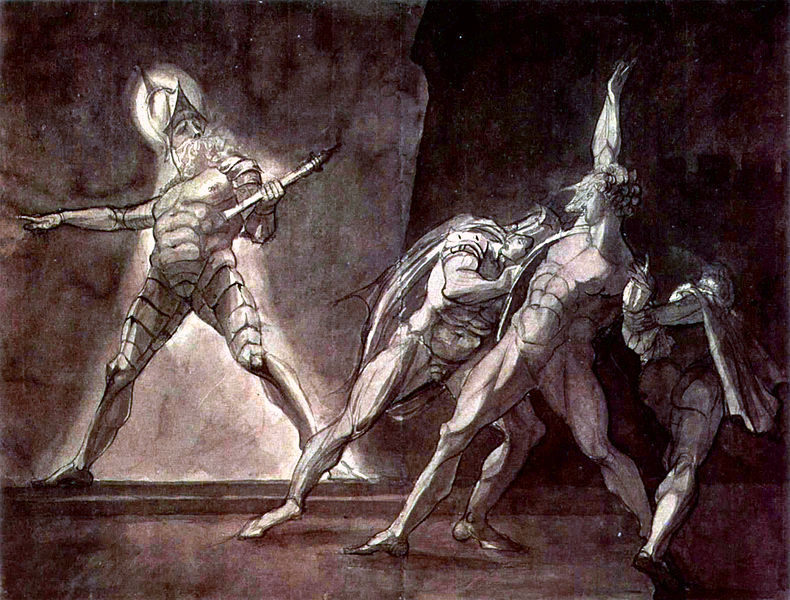
Hamlet’s father, on the other hand, is seen by the night watch at Elsinore castle, who then call this rather bizarre apparition to the young Prince’s attention. They all see the ghost.

But later in his mother’s bedroom, while Hamlet is criticizing his mom for having had carnival knowledge of his uncle Claudius, the specter of his dad shows up again. What’s remarkable is that the old King’s ghost, this time, is seen (and heard) only by his son – his mother sees nothing.
All of which leads to an obvious question: Did Shakespeare believe in ghosts?
My guess (cries of “For what that’s worth!” are heard in the background), is no, he didn’t.
He wrote a lot about witches too, but scholars point out that this probably had a lot to do with the simple fact that Will’s king, James the One, who was the playwright’s patron -- and, let’s face it, his boss -- was very occupied with witches. So Our Will wrote a play that concentrated so heavily on witches it might as well have been titled “The Witches,” but wound up as “Macbeth.”
So I conclude Shakespeare didn’t believe in ghosts or witches or a number of other supernatural types. But truth is, no one knows, or will ever know, just what Will Shakespeare did believe in.

Monday, June 20, 2011

Magpie 70


As I looked over this week’s Magpie prompt, a thought flashed through my mind:
Why, she could be the Dark Lady…
As you may know, Will Shakespeare wrote, in addition to the plays, a number of sonnets.
Quite a number – 154 of ‘em, in fact.
The sonnets were brief poems that touched upon just about everything: life, love, death, the passage of time, etc. By studying them, scholars over the years became convinced they could learn a lot about Shakespeare the man – his personal life and loves.

As one example, two dozen of the sonnets are devoted to a young woman who has come to be known as the Dark Lady. No one knows who she was but we know what she was: she was vivacious. tempestuous, witty, and very attractive. She’s called Dark because she had black hair and perhaps dusky complexion.
Our Will was crazy about her.
They evidently had a passionate relationship for a while, then she found another. To put it in modern terms, Shakespeare was dumped.
His girl had not only found another man, but it appears the new guy was a member of the nobility. What this meant, of course, in those days when social position was all-important, was that Will, a commoner, had not the slightest chance, not the slightest, of winning her back.
Why, he wondered, did I have to be what I am?
“I look upon myself and curse my fate.
Wishing me like to one more rich in hope,
Featur’d like him, like him with friends possessed.”
He wrote that he once saw the two of them together; his jealousy had boiled over. He began to write about his Dark Lady as though he could convince himself that she was a person it was good to be rid of.
In one of his most famous sonnets, he wrote a strange love poem, quite possibly unlike any other ever written.
The body of the poem is devoted to all the things wrong with his lady love – and there’s a lot.
“My mistress’ eyes are nothing like the sun.
Coral is far more red than her lips red.
If hairs be wires, black wires grow on her head.
I have seen roses damask’d, red and white,
But no such roses see I in her cheeks.
And in some perfumes is there more delight
Than in the breath that from my mistress reeks.”
But then, in the rhyming couplet that ends the sonnet, he goes on to emphasize just how crazy he still is about her.

Monday, May 23, 2011

Magpie 67


The Tournier banquet reminds us of one of Shakespeare’s most famous scenes: the banquet that Macbeth throws to celebrate his splendid new Kingship.
All the nobility and accompanying VIPs have been invited. Lady Macbeth, very experienced in such social occasions, is gracious to everyone.
There is actually an element of farce in this scene. It’s the kind of thing usually played for comedy: the elegant supper party where everything goes wrong. But the play’s audience is aware that the background of the scene is far from funny. The Macbeths have committed regicide; they have murdered Duncan, the previous King, though no one at the banquet is aware of this.
Macbeth’s second murder is to be of Banquo, a colleague, a friend. He doesn’t actually commit the murder; he has a hired killer do the deed. When he asks the murderer, “Banquo’s safe?” the man knows just what is meant. “Aye, my good lord, safe in a ditch he lies.”
And the banquet goes on, an event everyone is enjoying. Lady M. is in her element, charming all with her social poise.
But the pleasant occasion is wrecked beyond retrieval; Banquo shows up. He is, of course, a ghost, but Macbeth sees the real Banquo, sitting there in his chair. No one else sees him, of course.
The new King is visibly shaken, distraught; he cries out to his wife: “Can such things be?”
Lady M shifts into damage control mode. She tells the guests that the King is suffering a bit from an old illness, nothing to worry about.
Macbeth then cries out to the ghost: “Avaunt! And quit my sight! Let the earth hide thee!”
Lady M. decides that it would perhaps be better if everyone just left. “Good night! Stand not upon the order of your going but go at once.”

Tuesday, April 12, 2011

[For Sunday Scribblings and ABC Wednesday]
“M” is for “Mamillius”
The little kid with the funny name…

He’s very much like other boys his age. He likes to horse around, play games, tell ghost stories, etc. He’s featured in the play, “The Winter’s Tale.”
But there’s something special about this youngster, one of the most appealing characters ever created by Will Shakespeare: he’s a prince. His mom and dad are the King and Queen (only not in that order.) 

As princeling, he has two ladies-in-waiting assigned to be in charge of him. Naturally, he stands up to them.
First Lady
“Come, my gracious lord,
Shall I be your playfellow?”
Mamillius
“No, I'll none of you.”
First Lady
Why, my sweet lord?”
Mamillius
“You'll kiss me and speak to me as if
I were a baby still.”
Like most other young dudes of his age, he didn’t much care to have everyone kissing him and treating him as though he was still a toddler.
But Mamillius’ story is really a tragedy.
His mom and dad are constantly fighting. The King has charged the Queen with adultery – of which she is entirely innocent. This is serious stuff. If a queen is guilty of adultery, she has by law committed treason, which is punishable by death.
His dysfunctional family, the constant rows, take their toll on the youngster. His health is affected.

By the way, we should add that his father, though certainly not much as a husband, dearly loves his son.
But when the King throws his wife in prison and refuses to let Mamillius see his dear mother, the young prince becomes ill and dies. The monarch laments his poor judgment and promises to grieve for his dead son every day for the rest of his life.
So, it’s a Shakespeare tragedy. But there’s something else that's probably there by design, something that makes the sad story of Mamillius fascinating.
We remember that Shakespeare’s own son also died as a child. We can’t help wondering if Our Will had his boy in mind when he wrote of the death of the young prince.
I have always felt he was thinking of his dead son when he wrote these heart-breaking lines:
“Grief
Fills the room up of my absent child,
Lies in his bed,
Walks up and down with me,
Repeats his words,
Remembers me of all his gracious parts,
My fair son! My all the world!”

Monday, March 21, 2011

(Magpie 58, ABC Wednesday, Writer's Island and Sunday Scribblings)
“J” is for “January.”
Hamlet is very excited.
It’s January and it’s a bitter cold night in Denmark. We’re on a battlement of Elsinore Castle, where the young Prince has just learned that his late father was murdered, murdered by his own brother, the present King.


And Hamlet learned this from his father himself, who has appeared in the form of a Ghost who begs his son to avenge his murder.
Hamlet’s mind ranges wildly: was that really his father? Or could it have been an evil spirit, a fiend trying to trick him into performing an evil deed – to kill his uncle?


And of course there’s the possibility that he had imagined the whole thing. He has got to find out the answers to his questions.
He comes upon his two friends, who had also previously seen the Ghost.

Hamlet: “Good friends, as you are friends, scholars and soldiers, give me one poor request.”
Horatio: “What is it, my lord. We will.”
Hamlet: “Never make known what you have seen tonight.”
Horatio and Marcellus: “My lord, we will not.”
Hamlet: “Nay, but swear it.”
Both his friends readily swear to it.
But that’s not nearly enough for the young Prince. An oath is all well and good, but this is serious business. It calls for a special kind of oath.


Hamlet: “Upon my sword.”
Marcellus: “We have sworn, my lord, already.”
Hamlet: “Indeed, upon my sword, indeed!”
Quite astonishingly, the Ghost calls out from beneath the stage: “Swear by his sword!”
They swear again. Horatio's amazement is unlimited.

Horatio: “O day and night! But this is wondrous strange!”
Hamlet: “There are more things in heaven and earth, Horatio, than are dreamt of in your philosophy.”

Monday, March 14, 2011

(For Writer's Island, ABC Wednesday, Magpie 57 and Sunday Scribblings)

Shure, and what with the celebration of the shamrock so close, I got to thinking of the Irish in Shakespeare.
For example, there’s Captain Macmorris.

You see, I’ve always thought that of all the kings Will Shakespeare wrote about, and he wrote about a lot of ‘em, Henry the Fifth was the one he admired most.
Hank the Cinq represented what our playwright thought a monarch should be: wise, courageous, patriotic, daring, you name it – and of course he was the hero of what was possibly then the greatest military success in the history of England, the Battle of Agincourt.

To change the subject for just a moment, you remember all those movies about World War II, whenever they showed the crew of, say, an American bomber, the crew would be made up of one guy from Brooklyn, one from the Deep South, one from way out West, along with maybe a stoic New Englander. The idea of course was to show that all these various types, though very different, were inseparable when it came to fighting for freedom.

Well, Our Will did the same thing in the play “Henry V.” He features a few soldiers on the field who represent the main groups who made up the King’s army. There’s Fluellen, from Wales; Jamy, from Scotland; Macmorris, from Ireland; and of course Gower, the Englishman.
They’re always arguing and disputing – they’re soldiers, after all – but Shakespeare makes sure they're also inseparable when it comes to the battle.
In the play, they’re engaged in the part of the great battle that had to do with mining. You see, when you were laying siege to a fortress or anything that was strongly held, for centuries a common military strategy would be to dig underneath to put an explosive device under the place and blow it up.
The device was called a “petard.” If it blew up before you got it in place, you were “hoist by your own petard,” which is where that phrase came from.
Well, it’s Captain Macmorris, of all the group, who’s upset that the mining work is not going well. He believes that everyone is standing around talking, arguing, and no one is really doing their job.
Macmorris: “By Chrish’ law, tis ill done! I could have blown it up in an hour! It is no time to discourse. The trumpets call us to the breach, and yet we talk, and be Chrish, do nothing!”
(Shakespeare was not noted for his accuracy as far as Irish brogues were concerned. :-) )
But it’s kind of interesting that it’s the Irisher who shows the real dedication and expertise in the operation they’re all involved in.
Top o’ the morn to ye, Captain Macmorris!

Monday, March 7, 2011

[For ABC Wednesday, Magpie 56, Writer's Island and Sunday Scribblings]
“H” is for “Head Over Heels”
Think of a beautiful woman, perhaps the most beautiful woman you’ve ever seen.
She falls in love with a guy who has the head, a big head, of a farm animal.
And she falls head over heels.
That’s the story of Queen Titania and Bottom the Weaver.
You remember him – he’s the chap in Shakespeare’s “A Midsummer Night’s Dream” who has his head turned into that of a jassack. :-)

Nick Bottom – who knew he had a first name? – is a simple workman, with the emphasis on “simple.”
He and his fellow working stiffs are planning to put on a play for the Duke’s wedding day; if the presentation is successful each performer will be in line to receive sixpence a day for the rest of their lives. (Which would be pretty much like winning the national lottery as far as they’re concerned, so they’re all taking this production of theirs very seriously.)
But Puck, a crafty, not to mention cunning, little character with magical powers, a prankster par excellence, decides to have a little fun with them.
He does the deed with Bottom’s head and leaves him in the forest.

Along comes the spectacularly beautiful Titania, Queen of the Fairies. She is what Shakespeare would have described as a “looker,” if he had thought of it. :-) Check out those gossamer wings.
She has herself been enchanted by a love potion made from the juice of a rare flower – and you know how powerful that stuff can be – administered by her jealous husband, who has rigged things up so that she will fall for the first individual she sees after waking up.
He says: “Wake when some vile thing is near.”
The vile thing turns out to be our friend Bottom.

The Queen falls head over, to risk repeating myself, heels for this guy; they make a handsome couple. :-)
Titania orders her minions to treat him well:
"Be kind and courteous to this gentleman.
Feed him with apricocks and dewberries,
With purple grapes, green figs and mulberries;
Nod to him, elves, and do him courtesies."
And it's a tribute to Bottom that he can adapt to any situation; he takes all of this in stride -- he’s enjoying every minute.
Later, when he’s back to his true self, he tries to describe that adventure. He figures it must have been a dream:
“I have had a dream, past the wit of man to say! The eye of man hath not heard, the ear of man hath not seen, what my dream was!”
But now of course he’s aware they must all rehearse the play to be ready for the Duke’s wedding day.

(I knew, with a bit of luck, I’d be able to work this week’s Magpie prompt in here somewhere. :-))
Bottom: “Most important, fellow actors, eat no garlic, for we are to utter sweet breath, and I don’t doubt everyone will say, it is a sweet comedy!”

Tuesday, January 25, 2011

For ABC WEDNESDAY

“B” is for “Bush.”

As you know, the word “Bush” has a number of meanings. For one thing, it’s the last name of a recent American president, George W, of happy memory – or perhaps not so happy, depending on your politics. :-)

It’s also a sort of woody plant that has a thick clump of branches, among other definitions – and we may get some ribald ones in the comments column. :-)
I came upon the word used in an odd way in Shakespeare’s “As You Like It.”
The beautiful Rosalind, the star of the play, comes on stage at the end of the performance and gives a little “thank you” speech to the audience, during which she uses the phrase “A good wine needs no bush.”
I had to look that up. Turns out, Rosalind is making a comment about what we today call marketing.
Basically she’s saying, if you’ve got a product of good quality you don’t have to do a lot of promotion and advertising.

You see, in Shakespeare’s day wineshops would often have a branch of grapevine – Rosalind refers to it as a “bush” – hanging on the front door (the branch would usually be without the grapes), a way of letting the world know you can get wine there.
Her point is, if you sell great wine you won’t need the bush.

Of course, the really huge drink then was ale: everybody, including kids getting ready for school, drank ale – the water was dangerous. But wine was big for Elizabethans too. The famous Shakespearean comic character Falstaff practically lived on “sack,” a white wine.
“Sack,” in fack – er, in fact – was simply the French word “sec” (dry) translated into Elizabethan English.

Rosalind, of “As You Like It,” by the way, was one of Will Shakespeare’s most successful creations. She’s beautiful, intelligent, witty, charming – what more could you ask for?
Pass the wine please, I’m bushed. :-)

Wednesday, January 19, 2011

Magpie 49


Willow’s prompt this week got me to thinking of the number of centuries women had to wear such voluminous, all-enveloping dresses.

There’s not all that much difference between the clothing of a lady of the time of the prompt (1905) and a woman of Shakespeare’s day. In both cases, everything was covered; it was a moral issue.
Cole Porter: “A glimpse of stocking was looked on as something shocking.”
But that took me back to my early days of Shakespeare studies. What must it have been like for a lady to go out into the world wearing, for instance, the garment known as a “farthingale,” the name given to the style of female clothing that was fashionable in England in the 1590s?

The English got it from the French. In most cases, for most Elizabethan women, the farthingale was a fairly simple article of clothing. But for someone like the Queen, it was a production.
It consisted of, inside, one or more large hoops with horizontal stiffeners that radiated from around the waist in order to produce a flat platter-like shape when supported by the "bumroll." That word is not just me being vulgar; it was the actual term used by the English to describe the rear end of the farthingale – that covered the rear end of the woman.

In a well-made English farthingale a fashionable silhouette was created by having the dress worn at an angle ("low before and high behind"). In the original version, the French carried this to an extreme – as one might expect? :-)
As long as we’re discussing women’s unmentionables, there’s a natural segue to another equally unmentionable topic: how, and where, would such a lady, out for an afternoon on the town in Elizabethan London, go to the bathroom?
It seems there were few, if any, public toilets. What might be described as public urination was evidently more or less acceptable. For a man, you just found a vacant space on a lawn or field. For a lady, it is quite possible that the design of the farthingale was a great help in such a situation. She would find a suitable spot and there she would kneel, spread her clothing about her in a way that provided complete modesty and privacy, and then take care of nature’s call.

To change the subject just a bit, the whole topic of how audiences in Elizabethan theatres and playhouses, two or three thousand people, would go to the restrooms when there were no restrooms, is quite interesting and worth a future post.

Tuesday, November 30, 2010

For ABC WEDNESDAY

“T” is for “The Tempest”

I’d like to tell you about a tragic event, a shipwreck that happened some years ago – quite a number of years ago, actually; it was in 1609.
A ship named the “Sea Venture,” which was on its way to Virginia, was caught in a tempest, something that we today would recognize as a hurricane, and crashed on a dangerous island, a spot feared by all sailors of that day because of the rocks that surrounded it – they called it the “Isle of Devils.”

The ship was destroyed on the rocks, but all hands – 150 people and one dog – got ashore and lived to tell the tale.
They had landed on, of all places, Bermuda.


I have to admit that the place has changed a bit since then.
At any rate, the ship’s passengers learned, since they spent months there, that it wasn’t an isle of devils at all; in fact, it was a pretty great place to spend the winter. There was plenty of food: all kinds of edible animals and birds, and the sea around the island was chock-full of fish. The future governor of Virginia was in that group, as was the future husband of Pocahontas.

The ship’s crew used the timbers from their wrecked ship to build a different, much smaller ship, which they named “Deliverance.”
They waited till spring to set sail for Jamestown, Virginia.
Try to picture this situation. It was assumed by everyone, after nine months passed, that the folks on the “Sea Venture” had all died, and then they sailed into Jamestown, hale, as the saying goes, and hearty.
It would be as though we in our time were to lose a large crew in a spaceship that crashed on the dark side of the moon, and then they were to arrive back home, half a year later, in fine condition.

The news about the Sea Venture, when it got back to England, created a sensation. Will Shakespeare read about it and sat down to write a play, named, as you may by now have guessed, “The Tempest.”

For the playwright, the island was a magical, mysterious and enchanting place…
And he filled it with magical, mysterious inhabitants.


The main character of this play is Prospero, who lives with his daughter on this island. In exile, far away from everyone, he has somehow managed to acquire the power of magic to help him in his daily existence.

Beautiful young Miranda, his daughter, sees the shipwreck. She will fall in love with a young man, a survivor of the wreck. Why shouldn’t she? He’s just about the only man she’s ever seen, except for her father.

“The Tempest” is one of the most original and wildly creative of Shakespeare's productions. The human and imaginary characters, the dramatic and the grotesque, are blended together in a genuine work of art. Some scholars suggest that Prospero is really Shakespeare; when he gives us his thoughts and beliefs, he is speaking for the playwright. Well, I suppose it’s possible.
At any rate, this is the last play Will S. wrote, so when Prospero “signs off” at the end, it does indeed sound like Shakespeare saying good bye.
Prospero: “I have be-dimm'd the noon-tide sun, call'd forth the mutinous winds, and 'twixt the green sea and the azur’d vault set roaring war. But this rough magic I here abjure; I'll break my staff, bury it certain fathoms in the earth, and deeper than did ever plummet sound – I’ll drown my book.”
And some time later that’s just what William Shakespeare did: as in “The Tempest,” he drowned his book, writing no more plays and retiring to his home in Stratford.
 
Blog designed by Blogger Boutique using Christy Skagg's "A Little Bit of That" kit.