Showing posts with label Macbeth. Show all posts

Sunday, December 18, 2011

For Three-Word Wednesday, ABC Wednesday and Magpie 96

"W" is for "Whim"
In the old days, when my son was young, we tried home-schooling. A typical class would go like this…
“Did you find the play difficult?”
“Not really, Dad. I got through it okay.”
“Tell me about it.”
“Well, it’s about this couple, Lady Macbeth and her husband, Mister Macbeth.”
“That’s a good start. Go on.”
“They’ve got this friend – wait a minute, I’ve got his name here somewhere – yeah, it's Duncan; I knew it had something to do with donuts. Anyway, they’ve got this friend named Duncan who comes to visit. Didn’t turn out well. He sort of checked in and didn’t check out, if you see what I mean.”
“You mean he was killed?”
“You could put it that way.”
“And who did the killing?”
“Well, that’s the thing. They both were in on it, Lady MacB and her old man. Both of ‘em. At first it was just a whim; something they talked about, but then it got serious. Actually, MacB had a firm belief that you didn’t do stuff like that – kill your best friend -- but she egged him on. ‘You can do it! You de man!’ she’d yell at him, and like that.”
“So he went along and committed the murder?”
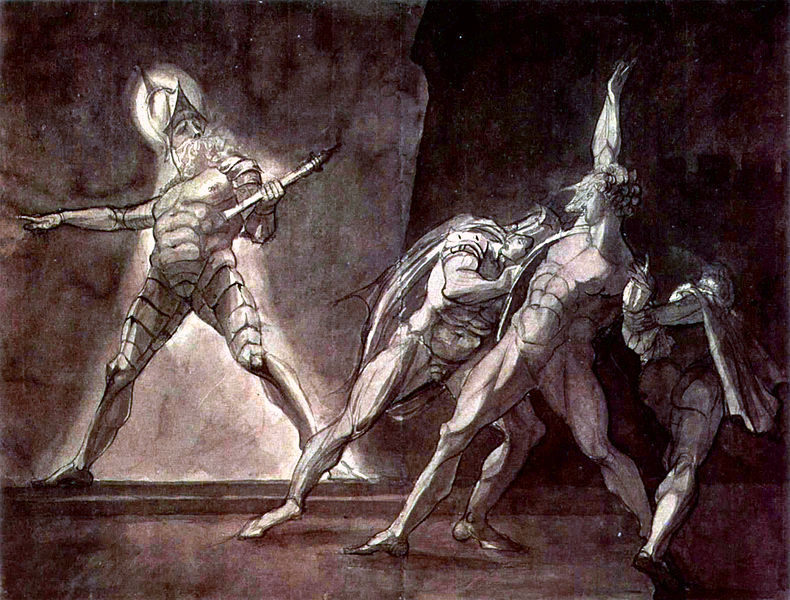
“Exactly. Here’s a picture of the couple after the killing.”

“H’mm. Some picture. She looks a bit rumpled, and he’s just a shadow.”
“You gotta remember that photography was very new in those days.”
“What about motive? Why did they kill Duncan?”
“Well, you see, Macbeth had a title; he was Thane of Cawdor. Now I guess Cawdor wasn’t much of a town so being Thane of it was sort of small potatoes, if you see what I mean. He wanted something better.”
“As did Lady Macbeth?”
“Oh, man, did she ever! She figured that if they offed Duncan she could wind up as First Lady. She’d be able to throw all the festive parties and so on. Which is exactly what happened.”
“But later she had a change of heart?”
“You’re assuming she had a heart to begin with. But yeah, after a while she began to feel pretty crummy about having liquidated their friend. In fact, it seems she was totally heading over to the unhinged side of town, if you follow my meaning.”
“You do have a novel way of putting things.”
“Show you how crazy she was, she had a dog named Spot. An indoors-type of pooch; never liked the outdoors. She’d yell at him: ‘Out, damned Spot!’ but he wouldn’t budge.”
“I see. A bit of humor.”
“Gotta do something to liven up these lessons.”
“What later happened to Macbeth?”
“Well, actually, I didn’t read any farther than this. As I get it, the dude wound up in a forest named Dunsinane, or something like that. Probably got lost in it. Things like that happened a lot in those days.”

Sunday, September 11, 2011

Magpie 82


I imagine most Magpie posts this week will have the tragedy of 9/11 in mind. I hope that something a bit different, my rather lighthearted piece on ghosts generally, may also be permitted.

You think of ghosts, you think of Shakespeare.
Or you should.
Because Will S. packed so many of these phantoms in his plays it almost seems they came out of the woodwork.
Which of course is what many ghosts do.
Look at the lineup:

First there is the specter who’s probably the most famous of the Shakespearean ghosts, Hamlet’s father. (His dad, by wild coincidence, was also named Hamlet.)

Then there’s the ghoul who wrecked Macbeth’s elegant dinner party, Banquo.


Of course we should also mention Julius Caesar’s pervasive spirit, in the play of that name, who comes back to remind everyone that he’s pretty ticked off about his assassination – as who wouldn’t be?
And we’ve got to add to the list the play about Richard III, Shakespeare’s Bad Guy par excellence, who pretty well hated everyone and who everyone, by the end of the play, pretty well hated him.

He had a whole platoon of ghosts come to torment him. (I counted eleven of ‘em.)
Some of these ghosts had lines; they had things to say. But there’s always been a question in my mind about these phantoms: who saw them?
Because Shakespeare wasn’t consistent. Sometimes the ghosts were seen by just one person; other times they were seen by many.
For example, Banquo, at the dinner party, is seen only by Macbeth; none of the guests at the banquet see him at all. Even Mrs. M – Lady Macbeth – doesn’t see him, yet she’s just as guilty of murder as her husband.
Hamlet’s father, on the other hand, is seen by the night watch at Elsinore castle, who then call this rather bizarre apparition to the young Prince’s attention. They all see the ghost.

But later in his mother’s bedroom, while Hamlet is criticizing his mom for having had carnival knowledge of his uncle Claudius, the specter of his dad shows up again. What’s remarkable is that the old King’s ghost, this time, is seen (and heard) only by his son – his mother sees nothing.
All of which leads to an obvious question: Did Shakespeare believe in ghosts?
My guess (cries of “For what that’s worth!” are heard in the background), is no, he didn’t.
He wrote a lot about witches too, but scholars point out that this probably had a lot to do with the simple fact that Will’s king, James the One, who was the playwright’s patron -- and, let’s face it, his boss -- was very occupied with witches. So Our Will wrote a play that concentrated so heavily on witches it might as well have been titled “The Witches,” but wound up as “Macbeth.”
So I conclude Shakespeare didn’t believe in ghosts or witches or a number of other supernatural types. But truth is, no one knows, or will ever know, just what Will Shakespeare did believe in.

Monday, May 23, 2011

Magpie 67


The Tournier banquet reminds us of one of Shakespeare’s most famous scenes: the banquet that Macbeth throws to celebrate his splendid new Kingship.
All the nobility and accompanying VIPs have been invited. Lady Macbeth, very experienced in such social occasions, is gracious to everyone.
There is actually an element of farce in this scene. It’s the kind of thing usually played for comedy: the elegant supper party where everything goes wrong. But the play’s audience is aware that the background of the scene is far from funny. The Macbeths have committed regicide; they have murdered Duncan, the previous King, though no one at the banquet is aware of this.
Macbeth’s second murder is to be of Banquo, a colleague, a friend. He doesn’t actually commit the murder; he has a hired killer do the deed. When he asks the murderer, “Banquo’s safe?” the man knows just what is meant. “Aye, my good lord, safe in a ditch he lies.”
And the banquet goes on, an event everyone is enjoying. Lady M. is in her element, charming all with her social poise.
But the pleasant occasion is wrecked beyond retrieval; Banquo shows up. He is, of course, a ghost, but Macbeth sees the real Banquo, sitting there in his chair. No one else sees him, of course.
The new King is visibly shaken, distraught; he cries out to his wife: “Can such things be?”
Lady M shifts into damage control mode. She tells the guests that the King is suffering a bit from an old illness, nothing to worry about.
Macbeth then cries out to the ghost: “Avaunt! And quit my sight! Let the earth hide thee!”
Lady M. decides that it would perhaps be better if everyone just left. “Good night! Stand not upon the order of your going but go at once.”
 
Blog designed by Blogger Boutique using Christy Skagg's "A Little Bit of That" kit.