
I imagine most Magpie posts this week will have the tragedy of 9/11 in mind. I hope that something a bit different, my rather lighthearted piece on ghosts generally, may also be permitted.
You think of ghosts, you think of Shakespeare.
Or you should.
Because Will S. packed so many of these phantoms in his plays it almost seems they came out of the woodwork.
Which of course is what many ghosts do.
Look at the lineup:
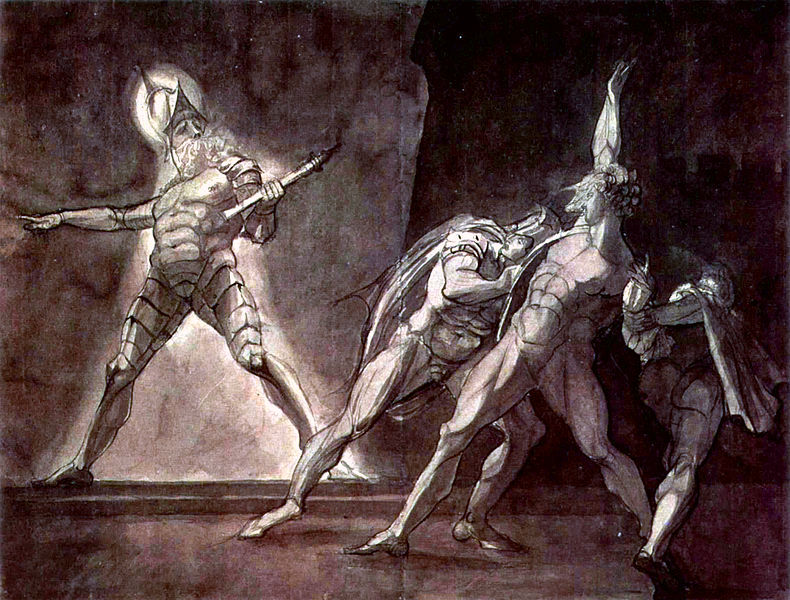
First there is the specter who’s probably the most famous of the Shakespearean ghosts, Hamlet’s father. (His dad, by wild coincidence, was also named Hamlet.)

Then there’s the ghoul who wrecked Macbeth’s elegant dinner party, Banquo.
Of course we should also mention Julius Caesar’s pervasive spirit, in the play of that name, who comes back to remind everyone that he’s pretty ticked off about his assassination – as who wouldn’t be?
And we’ve got to add to the list the play about Richard III, Shakespeare’s Bad Guy par excellence, who pretty well hated everyone and who everyone, by the end of the play, pretty well hated him.

He had a whole platoon of ghosts come to torment him. (I counted eleven of ‘em.)
Some of these ghosts had lines; they had things to say. But there’s always been a question in my mind about these phantoms: who saw them?
Because Shakespeare wasn’t consistent. Sometimes the ghosts were seen by just one person; other times they were seen by many.
For example, Banquo, at the dinner party, is seen only by Macbeth; none of the guests at the banquet see him at all. Even Mrs. M – Lady Macbeth – doesn’t see him, yet she’s just as guilty of murder as her husband.
Hamlet’s father, on the other hand, is seen by the night watch at Elsinore castle, who then call this rather bizarre apparition to the young Prince’s attention. They all see the ghost.

But later in his mother’s bedroom, while Hamlet is criticizing his mom for having had carnival knowledge of his uncle Claudius, the specter of his dad shows up again. What’s remarkable is that the old King’s ghost, this time, is seen (and heard) only by his son – his mother sees nothing.
All of which leads to an obvious question: Did Shakespeare believe in ghosts?
My guess (cries of “For what that’s worth!” are heard in the background), is no, he didn’t.
He wrote a lot about witches too, but scholars point out that this probably had a lot to do with the simple fact that Will’s king, James the One, who was the playwright’s patron -- and, let’s face it, his boss -- was very occupied with witches. So Our Will wrote a play that concentrated so heavily on witches it might as well have been titled “The Witches,” but wound up as “Macbeth.”
So I conclude Shakespeare didn’t believe in ghosts or witches or a number of other supernatural types. But truth is, no one knows, or will ever know, just what Will Shakespeare did believe in.


