
“U” is for “Unblemished.”
(As in an unblemished record.)
Good morning.
Our European History class will begin by studying the country of Spain, and we’ll start with the era before the Spanish-American War.
Take notes; this will be an important part of the final exam.
I thought that a good way to start off is with a certain musical work, an opera, something that, even if you don’t much like opera, I’m sure you’re all familiar with. The reason I’m using it for this class is that the particular musical work I have in mind says a lot about the customs, traditions and moral attitudes of that time.

It’s a story of an army man who was not just putting in his time before being released back into civilian society, but of a young career soldier who believed he had a great future in the Spanish Army.

When he wore the uniform and saluted his flag, he stood for centuries of tradition; he was constantly reminded of the glory days of the 16th and 17th centuries, when the Army of Spain was the most powerful and prestigious in Europe.

Let’s say his name was Don Jose. He was of course a young man of good family, all-important in those days, a capable, serious junior officer whose unblemished record unfortunately became – well, blemished. And all because of his love for a woman.
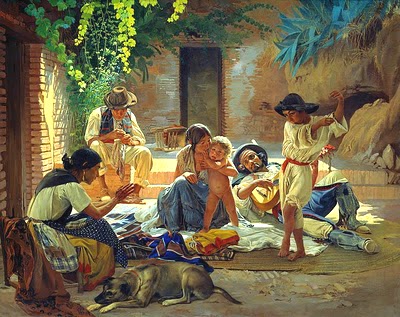
She was a Spanish Gypsy. The story of the Gypsies is the story of a persecuted minority. For centuries they had known discrimination, and this helped to create the powerful emotions – of tragedy, sadness, joy and love – found in their music and dance.

All of which ultimately led to the well-known flamenco of today.

The soldier named Don Jose had fallen hard for a beautiful, tempestuous Gypsy girl who had danced for him; he was even ready to take the next step, to leave his promising military career to be with her.
The punishment for this was severe; he was jailed. While he was behind bars a strange thing happened.

As he stood at the window of his cell she threw a flower to him. He caught it and was fascinated by the flower’s fragrance. Though the flower, as flowers do, wilted and became dry, the fragrance remained, and it was to keep alive for him the memory of the beautiful, incomparable girl for whom he had sacrificed so much.

Later, an operatic composer, Georges Bizet, was attracted by this romantic tale and composed a work that was to become a masterpiece, one of the most famous operas of all time. Among its best-known arias was one that had to do with the moment when the Gypsy girl threw the flower to the prisoner. (You’ve been able to figure out by now which opera we’re talking about?)
Here’s the scene:
Aria: “La fleur que tu m’avais jetee dans ma prison me’etait restee.”
“The flower you threw to me stayed with me in prison. It withered and dried, but it kept all the while its sweet fragrance, and I became intoxicated – because during the night I saw you!
“At times I took to cursing you, to cry out that I detested you. Why did destiny put you there, in my path?
“But then I realized that this was a kind of blasphemy because the only real feeling I had was a strong desire, a kind of desperate hope – to see you again, oh Carmen! To see you again!”


